• Alan has completed the new Pain Recovery Program. To read or share it, use this updated link: https://www.tmswiki.org/forum/painrecovery/
  • Welcome to the new TMS Wiki server! Things aren't finished yet: email is not set up, so notification and password-reset emails don't go out, and new registrations are paused until email is installed. Details and updates are in this thread (click here). Locked out? Email tmswikisignups@gmail.com from the address where you receive TMS Wiki notifications.

New Program Day 11: Pain Reprocessing

BB Thanks much for your informative reply! I appreciate your consideration of my views and thoughts. Obviously, you have given this subject much in depth thought and consideration. Hopefully, I have not extinguished anyones candle as that was not my intent but I can see how that could occur. I would like to respond to you but given that you brought up that separating some of the threads of this fabric might be detrimental to some, if you think it would be more appropriate to continue our discussion via pm, let me know. Thanks again!

hodini,

If memory serves I believe you asked on a different thread, what the possible advantages of the tms personality are. (Forgive me if recall fails but this beautiful evening I lack the heart to plough through posts.)

Essentially tms'ers are sweet souls who have not heeded their calling. Gifted with sensitivity, imagination, storytelling and what may be viewed as perfectionism but I prefer to see as a passion for manifesting a perfect form, they/we are artists. This is a broad stroke. Artistry can bloom in any endeavour so while many here ought follow more familiar creative paths, such as writing, dance, music and song, they could take their fine skills into architecture, cooking, physics or midwifery. Every field needs the daring and the brave. Dare we be daring and brave? It is easy to hide behind the intellect but as Leonardo da Vinci said "The noblest pleasure is the joy of understanding."
 
hodini,

If memory serves I believe you asked on a different thread, what the possible advantages of the tms personality are. (Forgive me if recall fails but this beautiful evening I lack the heart to plough through posts.)

Essentially tms'ers are sweet souls who have not heeded their calling. Gifted with sensitivity, imagination, storytelling and what may be viewed as perfectionism but I prefer to see as a passion for manifesting a perfect form, they/we are artists. This is a broad stroke. Artistry can bloom in any endeavour so while many here ought follow more familiar creative paths, such as writing, dance, music and song, they could take their fine skills into architecture, cooking, physics or midwifery. Every field needs the daring and the brave. Dare we be daring and brave? It is easy to hide behind the intellect but as Leonardo da Vinci said "The noblest pleasure is the joy of understanding."
Plum
I love your poetry of life, in life. I see you dancing across a field of meadow flowers on a beautiful summers day.
 
Essentially tms'ers are sweet souls who have not heeded their calling. Gifted with sensitivity, imagination, storytelling and what may be viewed as perfectionism but I prefer to see as a passion for manifesting a perfect form, they/we are artists. This is a broad stroke. Artistry can bloom in any endeavour so while many here ought follow more familiar creative paths, such as writing, dance, music and song, they could take their fine skills into architecture, cooking, physics or midwifery. Every field needs the daring and the brave. Dare we be daring and brave? It is easy to hide behind the intellect but as Leonardo da Vinci said "The noblest pleasure is the joy of understanding."

Exquisitely expressed.
Truth in Poetry.
A revelation and conciseness that explodes like stardust through the heart.

Plum ... you are truly the Wise-Woman, the Seer, the Dreamer, the Mystic Speaker for those of us who stumble through the brambles of confusion. Your words craft the most beautiful magic.

I am humbled and inspired ... <3<3<3
 
Exquisitely expressed.
Truth in Poetry.
A revelation and conciseness that explodes like stardust through the heart.

Plum ... you are truly the Wise-Woman, the Seer, the Dreamer, the Mystic Speaker for those of us who stumble through the brambles of confusion. Your words craft the most beautiful magic.

I am humbled and inspired ... <3<3<3
Ahhh, and Lily Rose has found the most beautiful way to describe our lovely Plum. We are fortunate to have such compassionate and gifted writers on this Forum.
 
If memory serves I believe you asked on a different thread, what the possible advantages of the TMS Personality are. (Forgive me if recall fails but this beautiful evening I lack the heart to plough through posts.)

Hi Plum,
Sort of....... my questions were surrounding several aspects of suggested methods of dealing with TMS and how they might enforce and so enable someones propensity to be a perfectionist. LOL, I totally understand the "ploughing" though! Fortunately for me I am a fast reader but still it is a daunting task being that there are over 10,000 posts on the site!

Personally, perfectionism is a part of my personality, that along with what some would call a control freak which is an extension of perfectionism. Fortunately, I have found outlets for my perfectionist traits where they are actually beneficial. One of the hats I wear is as a Project Manager specializing in architectural woodworking projects. As a fine woodworker, furniture designer and maker, I often find myself salivating over being able to achieve joinery that exemplifies perfection in my trade. That often takes me out of my comfort zone and into what can turn into stressful situations as the most minuscule of errors can result in my dissatisfaction ( not to mention the cost in time and material if I find it necessary to re-do) that perhaps most would not notice.

It also has given me the opportunity over the years to learn how to cope with how I handle this pressure and is a constant learning process. It also had for quite a while enabled me to be quite the authoritarian boss, mainly because of my difficulty in delegating responsibility and undertaking to take full responsibility for a project when something goes wrong. (duh.... its not a perfect world and things do go wrong!) Sometimes to the detriment of my employees and collaborators, I insisted on the "my way or the highway" ethic. I have mellowed with age, perhaps because I used to always strive to build in a way that it would long out last me and now, that might not be quite as long LOL. But seriously, after being confronted several times with this flawed while being effective way of working, I began to improve my communication skills and patience and see things in another perspective besides just my own.

Perhaps, having an occupation or hobby like woodworking, machinist, mathematician, scientist, where exacting measures and methods are appreciated helps to attenuate the negative aspects of perfectionism.

"Every field needs the daring and the brave. Dare we be daring and brave? It is easy to hide behind the intellect but as Leonardo da Vinci said "The noblest pleasure is the joy of understanding.""

So true! While the majority of my work requires a lot of forethought in order to be able to produce, some of my personal favorites have always been when I just dive in and let the work speak for itself and remove some of my control from it.
In other words, the machine slips, instead of tossing the work, I find a way in which to make it work rather then discarding my preconceived ideas and starting from the beginning.

I have read through quite a few of your posts and they echo a comfortableness with yourself which is admirable and I am sure a trait which aids you in facing your life challenges. I have enjoyed reading them.
 
Hi Plum,
Sort of....... my questions were surrounding several aspects of suggested methods of dealing with TMS and how they might enforce and so enable someones propensity to be a perfectionist.

Indeed. Many of us come to know ourselves by taking the propensity to be intense, perfectionistic and controlling into our initial attempts at recovery only to learn these are the very things that scupper us. This is especially poignant for me. I am the classic Type B personality. I don't possess the typical TMS personality traits but I managed to inadvertently pick some up during my early years as a carer. It was a way to deal with feeling so wretchedly over-whelmed. I became something of a super-nurse. Happily I have recovered from this and life is relaxed and simple once more. I feel for the Type A's.

But yes, your point is understood and observed, it plays out often in many posts. I view it as a learning curve, the point where we must grow eyes to look at ourselves. It does well to remain detached and find humour at this juncture.

LOL, I totally understand the "ploughing" though! Fortunately for me I am a fast reader but still it is a daunting task being that there are over 10,000 posts on the site!

I was a speed-reader (as distinct from fast) for years. I have retired that skill to the back-benches (tis good when reading journal articles), and favour reading slowly now. I have rediscovered the joy of pausing, relishing certain words and sentences, laying the book down on my tummy to smile.

As a fine woodworker, furniture designer and maker, I often find myself salivating over being able to achieve joinery that exemplifies perfection in my trade. That often takes me out of my comfort zone and into what can turn into stressful situations as the most minuscule of errors can result in my dissatisfaction ( not to mention the cost in time and material if I find it necessary to re-do) that perhaps most would not notice.

Ah, you are a craftsman. Wood is sublimely sensual. I imagine there is much pleasure in the nurturing of your vision and nimble yet tender intelligence in the hands that minister the rendering.
You care. That is quite lovely.

I have mellowed with age

*smiles*

perhaps because I used to always strive to build in a way that it would long out last me and now, that might not be quite as long LOL. But seriously, after being confronted several times with this flawed while being effective way of working, I began to improve my communication skills and patience and see things in another perspective besides just my own.

Caring/caregiving is a Masterclass in this. You have to enter the world of the other person.

Perhaps, having an occupation or hobby like woodworking, machinist, mathematician, scientist, where exacting measures and methods are appreciated helps to attenuate the negative aspects of perfectionism.

Attenuate is such a pleasing word.
I know well a former surgeon. We would all agree that this is an occupation where perfectionism finds healthy release. However I've seen this man cook and he brings a measure of being totally anal to the process that decimates any creative potential.

So true! While the majority of my work requires a lot of forethought in order to be able to produce, some of my personal favorites have always been when I just dive in and let the work speak for itself and remove some of my control from it.
In other words, the machine slips, instead of tossing the work, I find a way in which to make it work rather then discarding my preconceived ideas and starting from the beginning.

From cooking to sex to crafting to gardening, don't you find most activities benefit from getting messy.

I have read through quite a few of your posts and they echo a comfortableness with yourself which is admirable and I am sure a trait which aids you in facing your life challenges. I have enjoyed reading them.

Thank you.

(And don't worry, I shan't dissect future responses. It was nice to engage with you a little more.)
 
In continuation of my previous comment, the second prong of this program is meant to help you feel safer in response to, or in the face of, your pain symptoms.

I love what @bluesboy63 and @Cricket313 have to say regarding the pain cycle. The pain may start as a result of fear of [fill in the blank], but the pain perpetuates as you become afraid of the pain itself. This fear increases your pain, which increases your fear, which increases your pain. Onwards and onwards we go! Isn't that fun?

So how do we stop that cycle? By cutting off the pain's reinforcement: fear. All of the techniques you've learned thus far are meant to help you learn to respond to your pain without fear.

Hopefully, you are all becoming more aware of the thoughts you're having around your pain. Do your thoughts drift towards fear of structural damage? Towards fear of never getting better? Towards pressure to get rid of the pain? Towards criticizing yourself for not doing the techniques "right"?

All of these messages serve to reinforce the pain, and keep the cycle going.

So, what message do we want to give ourselves instead? That the pain, even if it hurts, even if you don't like it, even if it's frustrating...is safe. It's not confusing. We know exactly what it is. It is our brain misinterpreting something as dangerous. But we know now that you are not actually in danger. The pain cannot harm you. It may hurt, but it cannot harm you. The sensation you are feeling is safe. You are okay. You are safe.

I can see through your comments today that some of you are craving a bit more structure. I will provide a sample breakdown that you could use to get yourself started, but there truly is no one right way to implement these techniques. As long as you are working to treat yourself kindly and respond to your pain without fear, you're getting the swing of things. The following is simply an example of what a day in recovery might look like:

Start your day off with a brief mindfulness meditation. While we haven't specifically talked about mindfulness in this program, you don't need to know a single thing about it before clicking on this audio and giving it a try. It is simply a tool for watching the activity of your mind, which we learned about in the first few days of this program. This audio allows you to watch your thoughts (fear, pressure, and criticism thoughts) and let them go. This is a great way to start your morning, because it's setting a self-compassionate tone for the day.

Now, if that ten minutes of meditation is like drinking a tall glass of water, that doesn't mean you shouldn't be hydrating throughout the day. Continue to watch your thoughts and learn to catch the fearful ones, replacing them with more compassionate messages (See Day 11 on Cognitive Soothing). Every so often throughout the day, I'd like for you to simply place a hand on your chest and tell yourself that you are safe. I do this dozens of times per day. You can do this quietly to yourself absolutely anywhere. As you're driving to work, in a PTA meeting, at the grocery store, while you're watching TV...simply come back time and time again throughout your day to this simple and kind message: "You are safe."

As your day progresses, your pain might, too. In the busyness of your day, you might stop paying attention to how you're responding to it. You might be growing fearful or you might be pressuring yourself to power through it or ignore it. You might need a reminder halfway through the day that you know what the pain is, and that you're not afraid of it. Make it a point on your lunch break and/or halfway through your day to stop and listen to Alan's audio from today. It's an awesome way to practice responding to your pain without fear in real time.

The afternoon will turn to the evening, and you will notice your pain dozens more times. That's perfectly fine, it's okay to notice it. Every time you notice the pain, there is an opportunity to respond to it in a new way --without fear. These are opportunities to literally re-wire your neural pathways! You may want to continue using calming and soothing messages, or maybe you'll want to try standing up to the pain through empowerment (See Day 13). Both calming and empowering messages neutralize fear, and you can experiment with which category feel best for you.

As your evening winds down, take another ten minutes to check in with your body and do some somatic tracking (See Day 9). Go lay down somewhere quiet and spend a little bit of time attending to the physical sensations in your body. Close your eyes and follow whatever sensations you may be feeling - It there tightness if your chest? Is there tension in your shoulders? Is there pain in your back? Whatever it is, just take a few minutes at the end of your day to practice truly attending to the physical sensations of your body --without fear, without judgement.

Then, right before bed, tell yourself that you did your best for the day, and that your best was enough. No matter if your pain symptoms went up or went down, you did your part. Tomorrow will be another opportunity to tackle your fears and treat yourself kindly.

There you go, that's a sample day in the life of someone working to re-wire their brains and make themselves feel safer in the world! Those are no easy feats, but they are doable and you are capable. Practice makes progress and consistency creates change. Keep it up!

Hi Christie,

As you said the two prongs of this program are: 1). Helping you feel fundamentally safer, and 2). Helping you feel safer in response to, or in the face of, the pain symptoms themselves.

And you gave detailed daily routine to follow for 2) feeling safe in fear of pain. But I feel if you provide the similar daily routine to follow for the 1) overall feeling of safety, it would be very helpful to many here.

I feel when we are provided a structure to follow, we feel more faith in it and do it consistently with belief, which is how a new neural pathway is developed. So I will appreciate if you could provide a similar plan in general for the feeling of fundamental safety.
 
All the time. However, have you ever noticed that a good cry reduces your pain temporarily? It does for me. I used to never know why that happened, but since learing of TMS and feeling emotions, i think the crying is helpful. Dont hold it back, let it flow.
the last 2 years have been filled with thoughts like "i hope when i go to sleep tonight, i never wake up" or "i'm a damaged, broken human who was born wrong, and i dont belong on this planet." i would read about central sensitization (something that chronic painers develop because the whole nervous system gets jacked up) and think "well, that's it. it's incurable and my shit genetics have failed me, and now i've failed others. i'll NEVER get better."
those are the thoughts and phrases i'm trying very hard to to say or think. Now, as i stated abouve, i do take painkillers. If i dont (not sure i'd be able to keep a job) i go into wounded animal mode and i'm snapping, freaking out, and telling people i want to die, etc.
I' m so proud of you! I know that you feel worthless but all I can see from here is a person who is a huge fighter! Every day for the last half of year(that is how long I've been having this pain) there hasn't been one day that I didn't think about dying. But I'm still alive and so are you. I'm on vacation currently so I don't take medication, but I understand your need for them, I remember how it was hard to concentrate while I was studying. If it will do any better to your emotional state, I believe that anyone who had a chance to experience pain even for a short time would say you're so brave and determined! I wish you all the luck of the world in your healing process and don't give up!
 
I guess what I need to figure out is what is that "diligent work"? I'm not even clear yet what to DO. What "work" to do.
I ordered the Unlearn Your Pain book and the Unlearn Your Anxiety" book. So I hope they help with this.

The best book I've found so far that really ties everything together nicely is "The Great Pain Deception" by Steven Ozanich. I highly suggest it! As far as what work to do, I would make sure you have a good core understanding of TMS. It's important to know where and how it stared. If this program is your first introduction to TMS then in my opinion you will feel lost without having this understanding; like sitting down in the middle of a movie then wondering why you didn't understand it. This program is about the fear aspect of the pain cycle, how the neural pathways are caused, how ingrained they become over the years, and how to reverse them. That's the "work"...retraining the brain and creating new healthy neural pathways.
 
I love the Springsteen reference! It reminds me of one of my most useful tools to keep my head straight where TMS and anxiety are concerned. I have the Google Keep app which allows me to pin notes to my phone screen. Since I like many people are never far from my phone, I find that I glance at the notes frequently. One of my favorites is "Don't mistake excitement for anxiety...Don't mistake adrenaline for panic". Here is another: "Are you living life or simply existing? Take a break from being broken!" I feel like often we are so consumed with this syndrome and are so consumed with fixing ourselves that it's all we focus on which can be just as damaging. I would venture to guess that most of us also have OCD to some extreme. The obsessive part is what I have and it is a killer. Another good one: "I can't control my thoughts, I CAN control my reaction to them". As I come up with something relevant, I make a new note and pin it to my screen. Just thought I'd share...
These are things I say to my 11 year old all the time...guess I need to take my own advice! Thanks for the reminders! I have so enjoyed all your posts.
 
One thing that is extremely important to understand is how this all ties together. TMS theory has evolved for a long time. From Dr. Sarno's first book to his last, you saw the theory develop from "we may be on to something here" to "this covers so much more than pain and is a very real cure". All that said, Alan can correct me if I'm wrong, the pain starts initially with TMS, the psychological part, tension myositis syndrome. The brain creating pain via the autonomic nervous system to create a diversion from subconscious and unconscious thoughts that it feels need to keep buried. Once this pain is established, it's our focus, our every thought. Now that this pain is a part of our mental structure, here comes the cycle of fear, the cycle of pain, the neural pathways. This goes on for weeks, months, years and now it's a part of our every day lives. At this point, we can change the acronym of TMS from "Tension Myositis Syndrome" to "The Mindbody Syndrome". This is where the program we are currently studying becomes so important.

I feel that it is very important to initially deal with the initial aspects of repressed rage, etc if for nothing else, to understand fully the cycle of what you're dealing with and where it came from. However, I've found that once you're years into the pain cycle, these newer tools we're learning will be the ones that help the most. Also, I hate using the term pain cycle as I know many of us here have pain, but it's not our main issue. I can attribute anxiety, panic, sensitive stomach, numbness, tingling of extremeties, dizziness/vertigo, neurological issues, I could go on and on, all to TMS over the years. Back pain is a pretty easy one for me at this point in my recovery. As a matter of fact I woke up the other morning with horrible back pain out of nowhere. Using these new techniques that Alan has so graciously given us, I was able to work my way completely out of it within and hour. I'm developing the same skills with the chronic dizziness I've experienced on and off for pretty much my whole life as well. Onward and upward with an attitude of positivity and patience!


I love your easy explanation , I have all the above-mentioned symptoms but recently developed Vertigo/Dizziness. How are you using the TMS tools when dealing with dizziness?
 
Hi Alan, thank you so much for the recording. I actually just went through out and followed your instructions. I don't think I am fearful of my pain. But when I did focus on my pain, I felt my chest sinking (that sinking anxiety feeling), even though my mind and thoughts were totally cool and calm. Is that my body's way of signalling danger, even thought I might feel otherwise intellectually?
 
Thank you rbmunkin, I feel the same way. I need one of those lists too, lol- Im serious though. i think it would be really helpful. What ive tried in the past is to do just a little more when not in pain hoping my body sees that it is safe and then when im in pain to try to not get to upset or hope the pain goes but to breathe into my body and ask where is the pain and what does it feel like- it is hard because my go to is to be upset the pain is there and to worry when itll leave
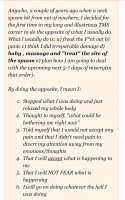
A list? Sorry to be so late to to chime in but I am attaching a screenshot I took of a TMS-wiki post months ago that was The List for me.
Just revisited this page because I am in fear of hurting myself in yoga. There is an asana where I am standing head to knee and my fear keeps telling me "You are gonna blow out your back again" and my mantra is "No fear, no pain, I am able, I am healthy and strong" and I go for it.
My back is fine! When I am angry, sad, bored, anxious, my psoas and lower back do this dance of fear and when I turn my curiosity toward it, as Alan did with the first recording in the lesson above, the pain moves, changes and eventually I smile and the pain evaporates.
It evaporates. Seriously.
It may return like a child wanting attention. I give it a moment and then say " feel a feeling, an emotion, not the physical noise" and I instantly feel a whoosh of either anger, sadness, fear, anxiety (fear of the unknown) (Future Experience Already Ruined) and then I am more real, more whole, less perfect, more human, vulnerable, lovable and...kind.
I hope the list is helpful. I wish I remembered who posted it. One of the grand old members, for sure.
Hang in there. This is a real solution, a real cure. There is freedom here.
Palms together,
Bg
 

Attachments

  • IMG_4185.jpg
    IMG_4185.jpg
    215.7 KB · Views: 1,331
A list? Sorry to be so late to to chime in but I am attaching a screenshot I took of a TMS-wiki post months ago that was The List for me.
Just revisited this page because I am in fear of hurting myself in yoga. There is an asana where I am standing head to knee and my fear keeps telling me "You are gonna blow out your back again" and my mantra is "No fear, no pain, I am able, I am healthy and strong" and I go for it.
My back is fine! When I am angry, sad, bored, anxious, my psoas and lower back do this dance of fear and when I turn my curiosity toward it, as Alan did with the first recording in the lesson above, the pain moves, changes and eventually I smile and the pain evaporates.
It evaporates. Seriously.
It may return like a child wanting attention. I give it a moment and then say " feel a feeling, an emotion, not the physical noise" and I instantly feel a whoosh of either anger, sadness, fear, anxiety (fear of the unknown) (Future Experience Already Ruined) and then I am more real, more whole, less perfect, more human, vulnerable, lovable and...kind.
I hope the list is helpful. I wish I remembered who posted it. One of the grand old members, for sure.
Hang in there. This is a real solution, a real cure. There is freedom here.
Palms together,
Bg
Awesome... I am trying to do the same.. If you get chance elaborate on "
When I am angry, sad, bored, anxious, my psoas and lower back do this dance of fear and when I turn my curiosity toward it, as Alan did with the first recording in the lesson above, the pain moves, changes and eventually I smile and the pain evaporates.
It evaporates. Seriously.
It may return like a child wanting attention. I give it a moment and then say " feel a feeling, an emotion, not the physical noise" and I instantly feel a whoosh of either anger, sadness, fear, anxiety (fear of the unknown) (Future Experience Already Ruined) and then I am more real, more whole, less perfect, more human, vulnerable, lovable and...kind."
 
Awesome... I am trying to do the same.. If you get chance elaborate on "
When I am angry, sad, bored, anxious, my psoas and lower back do this dance of fear and when I turn my curiosity toward it, as Alan did with the first recording in the lesson above, the pain moves, changes and eventually I smile and the pain evaporates.
It evaporates. Seriously.
It may return like a child wanting attention. I give it a moment and then say " feel a feeling, an emotion, not the physical noise" and I instantly feel a whoosh of either anger, sadness, fear, anxiety (fear of the unknown) (Future Experience Already Ruined) and then I am more real, more whole, less perfect, more human, vulnerable, lovable and...kind."
Was just getting offline when I saw your note asking me to elaborate on what I wrote.
For now, just imagine TMS recovery is a conversation between the frontal lobe of the brain - which is adult and reasonable and wishes for balance - and a child part of the mind which is underdeveloped, likely
located in the primitive amygdala (sp.) and that we are in the process of reparenting ourselves each time pain arises.
We learn to listen and not react, to feel everything and know it's okay to do so.
All best wishes,
Bg
 
I guess what I need to figure out is what is that "diligent work"? I'm not even clear yet what to DO. What "work" to do.
I ordered the Unlearn Your Pain book and the Unlearn Your Anxiety" book. So I hope they help with this.

I also read the books, but struggled on what to do. Then I tried the SEP program. Try it. It gives you daily reading and daily prompts for journaling and teaches you how to journal. Once you get the hang of journaling, it will be like flood gates will open and you will begin feeling things you never felt before. It will be awful at first. I'm on Day 33 of the program (it took me almost 45 days to get to Day 33) and I feel so much better now.

Alan's program, while incredible, is too abstract for me. However, SEP uses some portions of Alan's program and I found them incredibly helpful. It is as if I understood them when I had the structured context.
 
I feel that I have the opposite problem. I always check in, and I think that checking in regularly, from an anxiety perspective, amplifies my symptoms tenfold.
My primary symptom has been dizziness, but when I think about all the possible causes of my exact symptoms, it boils down to TMS a.k.a. a migraine. Ironically, when I do check-in without fear, it's challenging. More challenging than checking in with fear as I do this often. The fear makes it bearable because I have expectations of feeling worse.
So, I must ask then, how am I checking in during the day? The fear-based check-in amplifies the symptoms because of the what-ifs that are attached to it. And, the fearless, innocent check-in without expectations decreases the symptoms.
 
Hi,

This is really interesting....Since reading this I have tried catching myself in pain and then repeating the pain over and over. e.g. Bending down to get something from the bottom cupboard hurts but then as soon as i notice i then keep bending down and focusing on the pain and describing to myself what the pain feels like. This also seemed to work when doing yoga.

Is this safe/correct? Or have i gone into over drive

Thanks

Gemma
 
Hi,

Im danish so excuse my english. I am pretty sure I suffer from TMS but what keeps a little doubt in me is that i have never heard about anyone with the same symptoms as me. So I would like to hear if anyone here have the same symptoms or have heard about others who have these symptoms. My pain is related to my activity. If I walk or stand (for a while) I get pain in my feet. If I lay on one side I get pain in that side. If i write on a keyboard I get pain in my fingertips. If I dont use my fingers I wont get pain there. So all the pain is related to some physical pressure (mainly from gravity). Even laying on a soft mattress will cause pain eventually if I dont change position often. So its physical pressure on certain parts of my body that causes pain exactly where the pressure is. Also if I one time have overstrained a certain part of my body this part will in the future be more fragile than it used to be, meaning it will take less pressure to cause pain in the future. Does this sound like TMS symptoms?

Thanks

Anders
 
Last edited:
Back
Top