-
Alan has completed the new Pain Recovery Program. To read or share it, use this updated link: https://www.tmswiki.org/forum/painrecovery/
You are using an out of date browser. It may not display this or other websites correctly.
You should upgrade or use an alternative browser.
You should upgrade or use an alternative browser.
3. Can you work too hard at overcoming TMS?
- Thread starter Forest
- Start date


Forest
Beloved Grand Eagle
Glad to hear it. Take care.Forest: Thank you for the great post! I really appreciate the information and your time to give it here. This was helpful for me and I am sure it will be informative to many others as well. Thank you again! I will keep you posted.
joseph
Forest
Beloved Grand Eagle
I came across something from the Facebook page of Meditation teacher, author, and clinical psychologist Tara Brach this morning that is relevant to some of the themes in this thread.
Here's the picture:
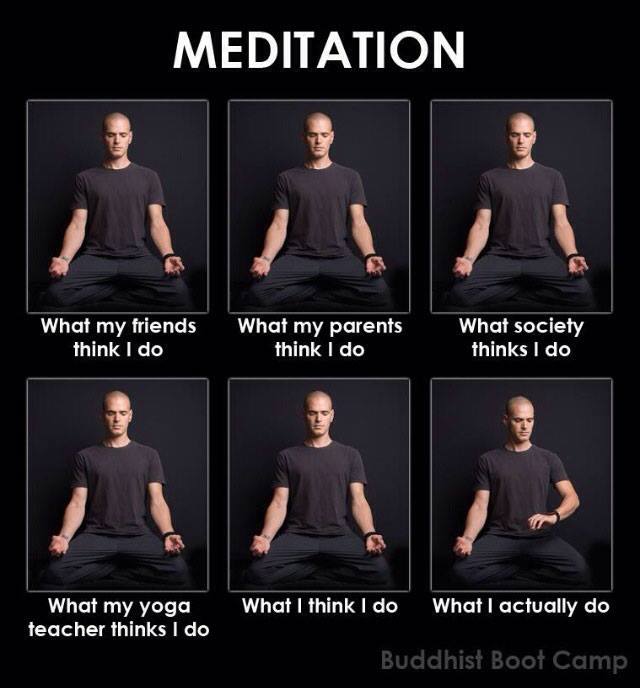
I thought it was cute. I bet that that guy is a very experienced meditator, but he is still, half the time, looking at his watch. The facebook comments reflect that he is not alone in this:
Here's the picture:
I thought it was cute. I bet that that guy is a very experienced meditator, but he is still, half the time, looking at his watch. The facebook comments reflect that he is not alone in this:
- Timothy Chen Allen - That's me: "Am I here yet?"
- Brian Drifting Spirit Dotson - Guilty as charged...
- Michael Lowrey - God grant me patience and tranquility... right now!
Coincidentally, meditation stimulates many of the exact same habits of mind and neural pathways that are so helpful in TMS healing. Like TMS healing, mindfulness meditation is something that you don't want to try too hard with. It is a practice, meaning that you just sit down and, well, practice being mindful.

Ellen
Beloved Grand Eagle
Just want to add that one doesn't have to 'sit down' to practice mindfulness meditation. It can be incorporated into any activity. Today in returning my shopping cart to the right place, I rolled it across the parking lot mindfully. It turned something I usually am annoyed about doing into something bordering on blissful. I'm trying to remember to do this more and more throughout my day. It makes such a difference. I'm using the trigger of slight irritation or annoyance as a prompt to become mindful.

Lily Rose
Beloved Grand Eagle
Just want to add that one doesn't have to 'sit down' to practice mindfulness meditation. It can be incorporated into any activity. Today in returning my shopping cart to the right place, I rolled it across the parking lot mindfully. It turned something I usually am annoyed about doing into something bordering on blissful. I'm trying to remember to do this more and more throughout my day. It makes such a difference. I'm using the trigger of slight irritation or annoyance as a prompt to become mindful.
Yes. Yes. And yes!!
Eating. Walking. Folding laundry. Petting the soul-companion (dog, cat, horse, goat, chicken, bird ... ). Tending the fire. Standing under the warm shower spray. Pulling weeds. Staring at shadows and sunlight. Eating an ice cream cone. All moments of easy meditation. Using the trigger of irritation ... very sweet!
with grace and gratitude,
^_^
Hi everyone,
I am really interested in your feedback on this one. I've been thinking a lot over the last week or so, and tried to make this video blog as thought provoking as I could. The hope is to jump start an interesting discussion that we can all learn from.
Links:
- Breaking the Pain Cycle, by Alan Gordon
- Structured Educational Program
Wow, I can't believe how timely this video is for me! Yesterday I had a rough day and broke down and spewed a lot of frustration at my husband who was actually listening compassionately to me. He is a medical doctor and wants to help me and part of me just wants him to fix me, to find a "cure" for my constellation of symptoms. After I apologized to him on the phone, I sent him a text saying that maybe I just needed to do nothing for awhile. I had journaled earlier that day about being so tired of trying so hard. I am so tired of trying to rid myself of my pain. I'm so tired of being obsessed with my pain! What does seem to help the most is meditation and yoga, two activities that I began recently. The yoga requires so much concentration and physical effort that I don't notice my pain while doing it. I have started doing meditations from Sharon Salzburg's book, Real Happiness, which I immediately found calming. I also like to do a Kundalini meditation called Sa Ta Na Ma, that an integrative medicine doctor in town told me about in a conversation. I think you are so right about focusing too much. Even as I do the structured program (I'm on day 7) and meditate each day I am realizing how preoccupied I am with treating my TMS, hoping I'm doing the right things and still doubting somewhat my self diagnosis. I know how powerful not caring and not focusing on a problem or physical condition can be! I had a diagnosed case of severe Achilles tendinosis and spent four months in intensive PT only to feel worse and be profoundly discouraged. In the months that followed I focused much less on my Achilles and returned to activities that I feared would hurt me, like tennis , which I had played competitively for years and the tendinosis went away. Unfortunately other physical symptoms appeared later. I believe mindfulness meditation and mindful living will help me. I also believe, as you warn us, that being preoccupied with it will sabotage its effectiveness. I will focus on balance, but will try not to try too hard....just listen to that!Hi everyone,
I am really interested in your feedback on this one. I've been thinking a lot over the last week or so, and tried to make this video blog as thought provoking as I could. The hope is to jump start an interesting discussion that we can all learn from.
Links:
- Breaking the Pain Cycle, by Alan Gordon
- Structured Educational Program
 the challenge is the delicate balance. Letting up and letting go is so hard for me, but I'm convinced it is key to getting better. I'm happy to have no assignments today in the structured program.
I'm also so happy to have watched your insightful video!! Many thanks!

nowtimecoach
Well known member
Thanks so much joannabev for reposting this video. It is also just what I needed to hear. I loved how Forest calls out the tightly coiled pressure cooker of a class TMS'er. That would be me, for sure! My biggest takeaway from the video, and there were quite a few… was when he says, "Deep inside is a voice that says "This is what I need to do right now." Bada bing Bada Boom! I continue to learn to stop when I'm feeling anxious, pressured, uptight… to try and find that deep voice, listen and take care of myself in a balanced and loving way. Thanks again for reposting this. ps I also love the days off assignment of SEP!!

BruceMC
Beloved Grand Eagle
joannabev, exclusively focusing on and obsessing compulsively about tendinitis-like symptoms seems to be the numero uno way most people intensify and perpetuate their TMS symptoms. And based on my own experience learning to detach from and disregard your symptoms are likewise the best way of breaking the TMS pain cycle. If you're always preoccupied with the pain in your back or the stinging in your knees or the tingles in your wrist (or whatever), you're doing exactly what TMS wants you to do: that is, not addressing and feeling undesirable and socially unacceptable emotions stuffed down deep in your unconscious. But here's the catch: You don't necessarily have to know exactly what those unconscious emotions are, just being aware of their existence often defuses the TMS cycle. Of course, some people do seem to need to go deep and find out what those unbearable emotions are exactly, but that's really their own choice. Having a felt sense of how the process of emotional repression works and is working in your own case is the key.
Last edited:
Thank you for encouraging me to listen to the voice deep inside me. That has helped me over the past week! I keep listening for the wise, helpful voice instead of the negative, fearful one.Thanks so much joannabev for reposting this video. It is also just what I needed to hear. I loved how Forest calls out the tightly coiled pressure cooker of a class TMS'er. That would be me, for sure! My biggest takeaway from the video, and there were quite a few… was when he says, "Deep inside is a voice that says "This is what I need to do right now." Bada bing Bada Boom! I continue to learn to stop when I'm feeling anxious, pressured, uptight… to try and find that deep voice, listen and take care of myself in a balanced and loving way. Thanks again for reposting this. ps I also love the days off assignment of SEP!!
Thank you for emphasizing the need to detach from and disregard my symptoms, which is easier said than done for me. I would love to hear about any specific tips or strategies that have worked for you. My pain is in my jaw, ears and neck, and upper back, which is hard to ignore.joannabev, exclusively focusing on and obsessing compulsively about tendinitis-like symptoms seems to be the numero uno way most people intensify and perpetuate their TMS symptoms. And based on my own experience learning to detach from and disregard your symptoms are likewise the best way of breaking the TMS pain cycle. If you're always preoccupied with the pain in your back or the stinging in your knees or the tingles in your wrist (or whatever), you're doing exactly what TMS wants you to do: that is, not addressing and feeling undesirable and socially unacceptable emotions stuffed down deep in your unconscious. But here's the catch: You don't necessarily have to know exactly what those unconscious emotions are, just being aware of their existence often defuses the TMS cycle. Of course, some people do seem to need to go deep and find out what those unbearable emotions are exactly, but that's really their own choice. Having a felt sense of how the process of emotional repression works and is working in your own case is the key.
BruceMC
Beloved Grand Eagle
Steve Ozanich says that when he was out running and he'd hurt in one area like his right lower back, he's shift his consciousness into another pain-free area, like his left lower back. You can learn to do this kind of mental shifting by practicing mindfulness meditation where you move your conscious awareness to different areas of your body moving from your feet to your lower legs to your thighs to your hips to your lower back etc. etc. and so forth. Once you've developed those abilities, you should be able to shift your focus from areas of your body with TMS symptoms to other others that are pain-free. Takes a while of practice doing mindfulness meditation, but the skills are really valuable ones that your can apply to your TMS recovery.
I have started doing some meditations outlined in Sharon Salzberg's book, Real Happiness, and one on them is a Body Scan meditation. With your recommendation I'll do this more frequently. Thanks!Steve Ozanich says that when he was out running and he'd hurt in one area like his right lower back, he's shift his consciousness into another pain-free area, like his left lower back. You can learn to do this kind of mental shifting by practicing mindfulness meditation where you move your conscious awareness to different areas of your body moving from your feet to your lower legs to your thighs to your hips to your lower back etc. etc. and so forth. Once you've developed those abilities, you should be able to shift your focus from areas of your body with TMS symptoms to other others that are pain-free. Takes a while of practice doing mindfulness meditation, but the skills are really valuable ones that your can apply to your TMS recovery.

Walt Oleksy (RIP 2021)
Beloved Grand Eagle
I just watched Forest's video and definitely agree, as do many people who post their thoughts in the forums,
that we may spend too much time and thought on journaling to learn our repressed emotions or
flaws in our personalities (perfectionis, goodism, etc.) that cause our TMS pain.
We need to achieve a better balance between thinking about causes of our pain and find more time to
live in the present because, as Forest says, "A lot of TMS happens in the present." He suggests spending
more time relaxing and being in the present.
Forest asked viewers to tell how they find this balance. Beach Girl says she stops work at 5 pm and
sits in the backyard and listens to the birds, or the rain because she lives in a rainforest climate.
She adds that she listens to television news and cooks. Cooking, to me, is very relaxing, but
not listening to the news. I almost never do and it doesn't pollute my mind with more reasonf
to be stressed and about things beyond my control.
Bruce says he takes long bike rides and lives in the present by being aware of what he sees as he
bikes. He bike rides while living in the present moment.
Ollin says he balances his time between TMS thinking and repeating affirmations to himself
such as "My pain is going away" and "I'm feeling good and healthy." That works for him,
but others such as Steve Ozanich says that keeps a person thinking about their health, or
their pain. It might be better to think about other, more pleasant things. I do this.
I think about wilderness canoe trips I've gone on in the Minnesota-Canada Boundary Waters
canoe country where I can still feel the warm sun on me as I paddle on a still lake,
hearing the sounds of loons calling to each other across the water.
Neo, in the Netherlands, finds balance and "feeling your feelings" by reading Eckhart Tolle's
book, The Power of Now.
I, too, have found journaling to be too much at times, because it pulls me back into a boyhood
that Steve emailed me was "a perfect storm" of TMS. Once I recalled the reasons why I had
anger about my boyhood because of poverty and parents divorcing, I should have let it go,
but I kept thinking about it, and those repressed memories came back strong to remind me.
We need to recall our repressed emotions, then let them go and live in the present. I began to
heal of back pain when I began to feel the healing process of forgiveness. If we forgive
others and ourselves, then we need to go on and live in the present. Too much time in
the past can be counter-productive.
Like Forest, I'd like to hear more examples of how others find a balance and spend time
away from journaling and thinking about their pain.
that we may spend too much time and thought on journaling to learn our repressed emotions or
flaws in our personalities (perfectionis, goodism, etc.) that cause our TMS pain.
We need to achieve a better balance between thinking about causes of our pain and find more time to
live in the present because, as Forest says, "A lot of TMS happens in the present." He suggests spending
more time relaxing and being in the present.
Forest asked viewers to tell how they find this balance. Beach Girl says she stops work at 5 pm and
sits in the backyard and listens to the birds, or the rain because she lives in a rainforest climate.
She adds that she listens to television news and cooks. Cooking, to me, is very relaxing, but
not listening to the news. I almost never do and it doesn't pollute my mind with more reasonf
to be stressed and about things beyond my control.
Bruce says he takes long bike rides and lives in the present by being aware of what he sees as he
bikes. He bike rides while living in the present moment.
Ollin says he balances his time between TMS thinking and repeating affirmations to himself
such as "My pain is going away" and "I'm feeling good and healthy." That works for him,
but others such as Steve Ozanich says that keeps a person thinking about their health, or
their pain. It might be better to think about other, more pleasant things. I do this.
I think about wilderness canoe trips I've gone on in the Minnesota-Canada Boundary Waters
canoe country where I can still feel the warm sun on me as I paddle on a still lake,
hearing the sounds of loons calling to each other across the water.
Neo, in the Netherlands, finds balance and "feeling your feelings" by reading Eckhart Tolle's
book, The Power of Now.
I, too, have found journaling to be too much at times, because it pulls me back into a boyhood
that Steve emailed me was "a perfect storm" of TMS. Once I recalled the reasons why I had
anger about my boyhood because of poverty and parents divorcing, I should have let it go,
but I kept thinking about it, and those repressed memories came back strong to remind me.
We need to recall our repressed emotions, then let them go and live in the present. I began to
heal of back pain when I began to feel the healing process of forgiveness. If we forgive
others and ourselves, then we need to go on and live in the present. Too much time in
the past can be counter-productive.
Like Forest, I'd like to hear more examples of how others find a balance and spend time
away from journaling and thinking about their pain.
BruceMC
Beloved Grand Eagle
Bruce says he takes long bike rides and lives in the present by being aware of what he sees as he
bikes. He bike rides while living in the present moment.
You can say that again, Walt. I hadn't gone for an evening bike ride out in the woods around Woodside for a couple of weeks and didn't realize what I was missing until I went out again last night for a spin around my favorite course in Woodside. When I was hurrying back to where I'd parked my car, I felt like my forward motion and the movement of my legs were all being integrated in my consciousness in one fluid motion. Still feel my unified even this morning. Of course, I've done the journaling of childhood issues, current stressors and personality traits three times in the past two years and noticed that each pass through the material didn't really reveal anything new, anything I hadn't found out already. So I'd opine that journaling is real good at first, but after a while it's like whipping a dead horse. Finally, you have to stand back and integrate what you've learned into your personality on a day-to-day basis through some kind of activity that creates mindfulness. It could be meditation, it could be breathing exercises, it could be EFT with tapping, it could just be taking a long bike ride or a hike in the woods. All I know is I sure feel good this morning after my bike ride last night!

David B
Well known member
I mediate several mornings a week doing my best to pay attention my breath and also the thoughts that sometimes carry me away. With practice you begin to separate yourself from those thoughts and notice how your "monkey mind" just keeps jumping from tree to tree leading ultimately to no place. This has really helped me to notice when I get carried away with negative thoughts when I'm not formally meditating.
I also like Dr. Hanscom's practice of focusing on your five senses throughout the day. The sounds, smells, etc. that are all around. They are what is real in any given moment and bring you to the present. They remind me how blessed I am to be alive to experience them.
These help me to "do my thing" or as my grandmother used to say "get on with it". What is "my thing", "it"? What are these things to any of us? Living our lives. Which I know easy it is to say when TMS has subsided and how hard it is to do when you are in the TMS swamp. Actually its not that easy to do even when you arent in the swamp, that monkey has driven our behavior most of our lives, but is sure is worth the effort.
I also like Dr. Hanscom's practice of focusing on your five senses throughout the day. The sounds, smells, etc. that are all around. They are what is real in any given moment and bring you to the present. They remind me how blessed I am to be alive to experience them.
These help me to "do my thing" or as my grandmother used to say "get on with it". What is "my thing", "it"? What are these things to any of us? Living our lives. Which I know easy it is to say when TMS has subsided and how hard it is to do when you are in the TMS swamp. Actually its not that easy to do even when you arent in the swamp, that monkey has driven our behavior most of our lives, but is sure is worth the effort.

Ollin
Well known member
Ollin says he balances his time between TMS thinking and repeating affirmations to himself
such as "My pain is going away" and "I'm feeling good and healthy." That works for him,
but others such as Steve Ozanich says that keeps a person thinking about their health, or
their pain. It might be better to think about other, more pleasant things. I do this.
Walt, thanks for referring to my post from 2 years ago (page 1 of this thread), but I'm afraid it lead to some misunderstandings. First, I'm a woman
. Second, I did not say that I spent my time repeating affirmations, but rather shared my thoughts on what I learned about the helpful and unhelpful language one can use to formulate them. In a nutshell, there's nothing wrong with positive and life-affirming words (for me "health"is one of them), but words like "pain" are clearly negative to anyone I know, and so should be avoided.Anyway, this was written long ago, and I don't remember if my affirmations worked or not, but I know I'm rarely using them currently. We won't get anywhere unless we are open to believing what we say to ourselves. If we say the obvious, there's no progress either. We need to listen to, reassure, calm and gently challenge our subconscious mind, both during "the work" and playtime. The inner child wants to feel acknowledged. And certainly she wants to have fun. So long as she's not under pressure to enjoy something.
Last edited:
Walt Oleksy (RIP 2021)
Beloved Grand Eagle
Thanks, Ollin, for clearing that up. It's tricky replying to older posts. Things can change or be misunderstood.
Glad you replied. Be well, stay well.
Glad you replied. Be well, stay well.

Gigi
Well known member
Things that work for me are:
Having said that, I'm in the midst of a week-long bout with TMS that I haven't shaken yet. But the good news is, I know I WILL shake it
- daily morning meditation before I leave home
- swimming 2-3 times/week and doing yoga once/week
- focusing on healthy living
Having said that, I'm in the midst of a week-long bout with TMS that I haven't shaken yet. But the good news is, I know I WILL shake it

Marian
Peer Supporter
Thank you for this video, Forrest. I had just decided, at around day 31 or so, that the journaling and constant thinking about TMS was making my symptoms worse, because of the increased preoccupation. It was as though I was thinking psychological, but doing too much monitoring. It felt unbalanced. So I decided to take a break, which has helped calm things down. The word activated is absolutely great. Being activated as opposed to allowing. Thanks again. I do love and so far have received tons of insight from the SEP, and am very grateful that Alan Gordon's program is available because he touches on some extremely important points.
We're all different, but I find that when I focus on trying too hard it defeats the purpose. Forgetting about it for a while helps!
We're all different, but I find that when I focus on trying too hard it defeats the purpose. Forgetting about it for a while helps!