Penny2007
formerly Pain2007
Just saw this video and thought there's a lot TMSers can learn from this girl, especially about being joyful.
Last edited:


Just saw this video and thought there's a lot TMSers can learn from this girl, especially about being joyful.

I just read an obit a day or so ago about the scientist who discovered 'brain plasticity'. She was quite elderly. I hadn't heard of brain plasticity before, but it sounded like something that would tie in to TMS healing. Today I read of it in your post, Forest. Synchronicity works in mysterious ways.

Loved this. We make stuff up. I always remind myself I am not living in Afghanistan. Not living in Syria. There is so much to be grateful for!I appreciated the story of the monks. I decided if they could do that, I could try it on my first "battle" of the day which is getting everyone out the door. I think I view too many things as battles when they are really opportunities to find joy, love or gratitude. Thanks for your message.


Day 20: Embracing Joy
Every year at UCLA, there’s an event called Spring Sing. 5000 people pile into a stadium to watch students compete in different singing categories.
For three years, my friends and I had the task of writing the comedy pieces in between the acts. We wrote off-the-wall parody songs like, “Roommate from Hell,” “Three Finals in One Day,” and the ever-controversial, “Sorority Song.”
It was SO much fun.
After a sequence of unlikely events, we managed to turn this hobby into a job. Colleges actually started paying us to write and perform comedy songs at their events.
It seemed like a dream come true, but it wasn’t.
It had become a paid gig. And this thing I once loved and did freely had become infused with pressure, urgency, and expectations. After two years, I gave it up. The joy was gone.
The Drive for Change
We’ve discussed a lot of techniques over the past few weeks: somatic tracking, communicating messages of safety, embracing a stance of empowerment, etc.
As you began implementing these techniques, was there any joy behind the actions, or was it infused with pressure, urgency, and expectations?
There’s a bizarre paradox in trying to overcome our symptoms: The very act of trying to get away from something can activate our brains’ danger signals. So in trying to escape a pain-state, we’re often generating the very energy that causes pain.
Techniques can be helpful, but they matter less than the energy behind the techniques: Is there desperation behind your words? Is there an urgency behind your actions? Are there expectations for a desired outcome?
Or, is there an ease in your demeanor? Is there an enthusiasm to embrace positivity? Is there joy?
In short: Are you running away from something, or are you running toward something?
Joie de Vivre

The term “Joy” can mean different things to different people: It may make you think of pleasure, it may make you may think of happiness, it may make you think of an underwhelming Jennifer Lawrence movie (they can’t all be winners…)
But joy is an emotion. It’s a physical sensation that we feel in our bodies. For most people it feels good. For some it feels scary (as there can be a fear of it being taken away.)
But generally speaking, it’s a sensation that’s on the other end of the spectrum from desperation, pressure, and urgency. It’s the type of thing that we can gravitate toward, instead of away from.
This begs the question, is joy something that we can generate?
Actually, it is.
Joy Story
Guillaume Duchenne was a nineteenth century French neurologist. He discovered numerous diseases, invented electrotherapy, and conducted the first ever biopsy…but in his copious free time, he studied emotional expression.
Duchenne identified a distinct type of smile, one that didn’t just didn’t just involve the muscles around the mouth, but the muscles around the eyes as well.
As an example, let’s look at Julia Roberts, owner of one of the world’s most famous smiles:
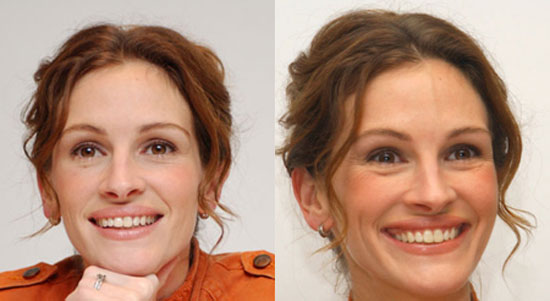
She’s smiling in both pictures, but in the one on the right, both her mouth muscles and her eye muscles are engaged.
They’ve found that when people smile in this way, dopamine and serotonin are released in the brain. These neurotransmitters are associated with feeling good.
Obviously joy can lead to smiling, but smiling can actually lead to joy as well.
In a study at Berkley, researchers asked participants to smile with both their mouth and their eyes. They found that this “Duchenne smile” was so effective, 95% of the people who used it felt authentic joy.
This isn’t to say that you should walk around with a huge smile on your face all the time, but it can be a effective exercise to practice honing the emotion of joy.
Leaning in to Joy
Chronic pain is exhausting. When you have continuous back pain, or head pain, or stomach pain, everything takes more energy.
During the times when you don’t have pain or your pain is reduced, things are so much easier.
Realistically, it’s kind of silly to tell someone “don’t care about getting rid of your pain,” because how can you not want to get rid of something that’s so debilitating?
So I won’t suggest that you try not to get rid of your pain. Because you can’t not try.
But I want you to see if you can do something else. Check in to your body for a moment. Breathe in, and feel the physical sensation of the breath come in and out.
Take a moment, as you’re reading this sentence, and take another deep breath in and out…really see if you can feel the sensation of the breath as it comes in and out.
Now smile big, with both your mouth and your eyes.
Here, I’ll see if I can help you:

And as you breathe in, smiling this big, Julia Roberts-smile, what do you feel inside your body? Attend to any sensations that arise…whatever they are.
And take a moment or two, before you continue reading, and just observe.
In that single moment, you weren’t attempting to get rid of your pain…you weren’t trying to escape, you were leaning in to a sensation, with curiosity and openness.
The many times when we find ourselves trying to get rid of our pain – pushing, struggling, pressuring – this is simply a natural drive for an organism that’s in a state of suffering. And it’s going to happen.
But it’s those other times – the ones where we gravitate toward joy, the ones where we enthusiastically embrace empowerment, the ones where we authentically aim to calm our primitive brains – these are the times where we’re truly take steps to alleviate our symptoms.
As Plum brilliantly put it in the Day 17 comments, “You overcome pain incidentally, on the way to creating a happier, healthier brain ecosystem.”


I keep cycling through this Pain Recovery Program. The information is dense and has made sense to me on different levels each time I go through it. And each time through different insights impress me in different ways--new and instructive ways. This morning, it's this comment by Plum. You collect an incidental win on the way to some higher goal you've set for yourself, similar to the way that by changing behavior--going to really different places, etc.--we incidentally bring new people into our lives and so have new relationships and experiences that wouldn't have had otherwise. Plum's comment is a nice way to think about taking the focus off of the grim determination to Get Rid of It and instead focus on what is light and joyful in life, what you can find to celebrate--whatever that might be. Here is a way to grasp without using your hands. There is a lot of paradox in this program, which seems right to me--frustrating at times--but right all the way down to the deepest levels.As Plum brilliantly put it in the Day 17 comments, “You overcome pain incidentally, on the way to creating a happier, healthier brain ecosystem.”


I was wondering the same thing, as I don't see many recent posts. I started this program in the spring and when finished I will be re-reading all of my notes and bookmarks and probably starting the program again. I'm on my 3rd Sarno book now. I don't think I will ever finish, but that is a good thing. I have learned so much and come a long way after 18 years!This is my second time through this amazing course. I loved it the first time and began to practice some wonderful new tools, especially somatic tracking. But I found myself wanting more. Somewhere I read that it is a good idea to go through the whole course again, this time reading the comments. Bingo! It is sinking in.
Alan’s post today really resonated with me! I have read the Sarno books and have done Nancy Selfridge’s course for people dealing with fibromyalgia. I have learned a great deal about myself — how I respond to pain; emotions stuck where I didn’t want to deal with them; and what I need to do to begin to heal. But I’ve been working so hard at feeling better that I’ve been overwhelmed by struggle, resistance and disappointment. I remember the joy and excitement I felt when I first learned about the Sarno approach and read the first book, realizing that my fibromyalgia symptoms are TMS. I have had TMS difficulties for over 30 years, so I know that it will take some time to unlearn my pain and responses to life! But this course and especially this lesson on finding joy are so important!
Thank you, Alan, I have found my enthusiasm once again! I’m excited to continue to practice replacing my fear with joy! Thank you all for your insightful comments. Is anyone else doing this course currently?