Day 2: The Nature of Pain
To better understand the treatment techniques we’ll be going over in the coming days, here are two basic premises you should know about pain.
Premise 1: Pain = Danger
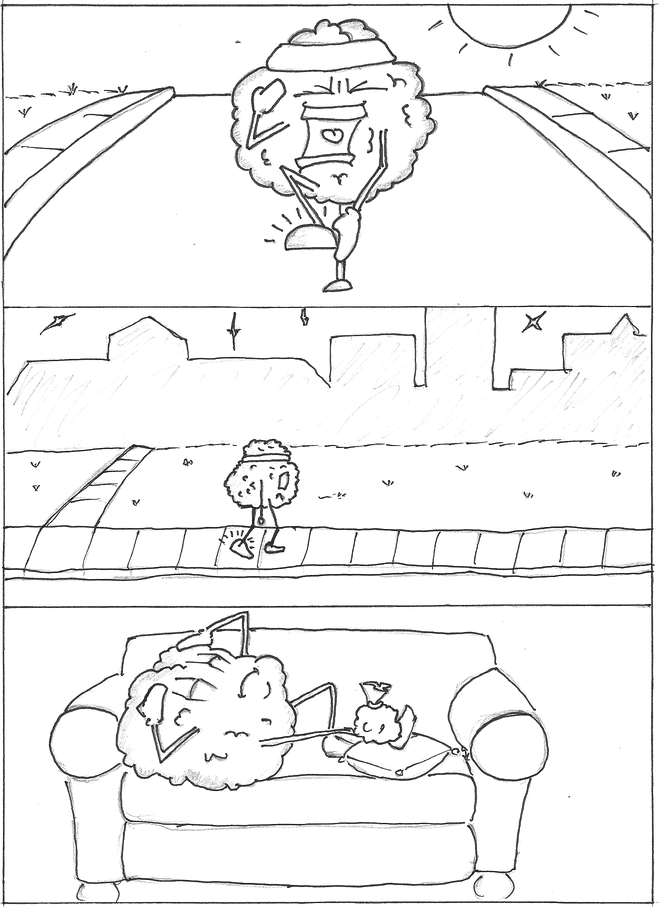
Imagine that you're out on a run. You're listening to music, enjoying the early morning breeze, and pondering the mysteries of nature. Suddenly you trip over your shoelace, come down awkwardly on your left foot, and feel a sharp twinge. You've sprained your ankle. Frustrated, you limp home, wondering how bad the swelling is going to be.
As awful as it feels, pain is meant to help us. It’s our brain’s way of saying: “You are at risk of causing tissue damage, kindly back off until we heal.”
Without pain, you'd have no idea that you sprained your ankle, you'd continue running, and you'd injure yourself even worse.
Put simply, pain is our brain's way of screaming: DANGER!
Premise 2: Our brains are not perfect
Throughout human history, our brains have developed the capacity to achieve some remarkable feats. We’ve unlocked the secrets of DNA, we’ve discovered the boundaries of the universe, and we’ve invented 72 distinct flavors of Oreos (Nabisco, you had me at “triple double chocolate mint.”)
But our brains are not perfect. In fact, sometimes they can get downright confused.
Over millions of years of evolution, we have developed different signals to warn us of danger. Pain warns us of causing additional tissue damage, fatigue lets us know we need to rest, even hunger warns us that we need to refuel with food. And usually these signals work out great.
When you’re in pain, you rest the injury so it can heal. When you’re fatigued, you take a nap so that you can recover. When you’re hungry, you have a glass of milk and some Berry Burst Ice-Cream Oreos.
But, our brains never developed a system that can perfectly distinguish one type of danger from another. Oops.
This means that sometimes our danger signal can get activated
by mistake.
Let’s look at anxiety as an example. Anxiety is a danger signal that developed so we could run faster or fight harder when we’re faced with a physical threat.
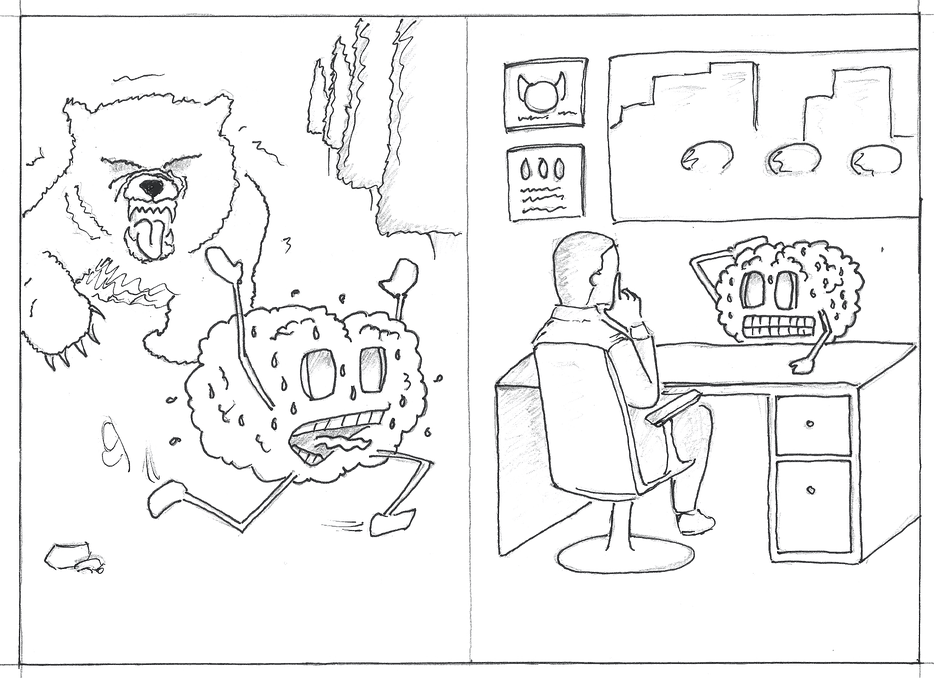
Anxiety is great when a bear is chasing you, but it’s not so helpful in the middle of a big job interview.
And since the brain can’t always distinguish one type of danger from another, it can respond to a psychological danger (I really hope I don’t blow this job interview) as if were a physical danger (I really hope this bear doesn’t eat me).
This is why we can develop anxiety even in situations where our lives aren’t in danger. Our brains are misinterpreting the nature of the threat, and activating the wrong danger signal.
To see some examples of other psychological dangers (as well as how they can develop) watch the following clip:
Developing TMS
You may be asking yourself, what does any of this have to do with pain?
Remember, pain is a danger signal too. So when we sense a psychological danger, our brains can misread the situation and respond with pain. It’s simply another case of our brains activating the wrong danger signal. This is how we can develop pain
even if there’s no actual tissue damage.
Isn’t neuroscience fun??
Here’s a story to illustrate these concepts.
One night during my second year of grad school, I was studying for a big final exam. I needed to do well so that I could get a good GPA so that I could get a great job so that I could make a lot of money so that I could pay off my grad school loans (ah, the circle of stress…)
Out of nowhere, I developed terrible back pain.
Let’s look at what happened. There was a psychological stress (If I don’t do well on this test, I’m going to end up poor, unemployed, and living with my parents.) My brain sensed danger, it misinterpreted what the actual threat was, and it flipped the wrong danger signal: pain.
And that’s how we can develop pain even when there’s no injury.
TMS Treatment
Assuming that you have TMS, there are two main goals to overcoming your symptoms.
1. Teach your brain that the pain is not dangerous
2. Teach your brain that the psychological stressors that it learned to fear (anger, sadness, confrontation, intimacy, etc.) are not actually dangerous.
For the next three weeks, we’re going to work on achieving these goals. You’re going to learn new techniques to confront your fear, overcome psychological barriers, and work toward deactivating your danger signals.
In other words, we’re going to try and give your brain the thing it needs most: a feeling of safety.
![[IMG]](http://www.tmswiki.org/image/brain.png)