I've been studying TMS for about 16 months now, and I continue to be confused about what constitutes effective treatment. Maybe this is partly due to the fact that while I have eliminated my TMS pain syndromes, I am still dealing with TMS equivalents, and therefore, not completely recovered. I'm intrigued by the idea of recovery occurring through the "reading and rereading approach" discussed by Forest above. I don't like digging up the past and attempting to process the emotional content I uncover, so I would be happy to jettison this approach.
Thanks for bringing this up, Ellen. I always love your posts. You take time to think things through and write with great psychological insight and unselfish, other-centered care. This post, in particular, brings up some vital points that are worth looking at for everyone.
I think it is prudent to be very agnostic about how we interpret TMS theory. I am a big fan of something called the pessimistic induction:
http://en.wikipedia.org/wiki/Pessimistic_induction
Before I switched majors to math and computer science, I was a philosophy major for three years in college, and I
loved studying philosophy, even though I could somehow never get myself to finish the reading.

Our department took a historical approach to philosophy, so I've read a great deal of old philosophy, from ancient to early-modern and contemporary.
What struck me was that every one of the major thinkers that we read thought that they had finally figured everything out.
Every one. Each one of the thinkers seemed to think that they had reached the pinnacle of philosophy and that it was finally done. We could all go home now because philosophy was finally a science and we had figured it out.
Yet,
universally, the next thinker to come along disagreed with them. They said that the previous thinker (i.e. the one who thought they had all figured it out) was also wrong. But now, finally, this next thinker claimed that they had finally figure it all out. Not surprisingly, the thinker who came
after them disagreed. And so on.
Loosely speaking, induction just means learning from experience, so the pessimistic induction is a warning to scientists and philosophers. We may think that we have finally figured everything out, but that is just hubris. The next great thinker to come along will congratulate us for our contributions and explain that we actually didn't have it quite right.
That's fine. They're right. We don't understand things as well as we think we do. No one does. The human brain has roughly 86 billion neurons and 100 trillion synapses, and what we understand about it is absolutely dwarfed by what we don't understand. We have many neat experiments, but we fundamentally don't know
how it works.
I have
a lot more to write, but I'm afraid that I've got a huge amount of work to do before Sunday and have written too much already!!
The bottom line is that I salute your interest in the idea of collecting additional information. Fundamentally, we all know that something amazing is happening here. We all know that people's lives are being transformed because we see the stories popping up in our
success stories subforum. Many people have different theories about what causes the changes that we see, but I think that we are wise to acknowledge that we don't fundamentally know what causes people to heal. As a group, we are all in the situation that you described:
When I learned about TMS and TMS healing techniques I used the "scattershot approach"-I tried everything I could all at once. As a result, I am uncertain which of the myriad techniques I've used have been essential in getting me this far along the road of recovery. Could I have eliminated everything but the "knowledge therapy" described in Healing Back Pain? If I read and re-read my Sarno and other TMS books will this be sufficient to carry me all the way to recovery? I feel the other techniques contained in Alan Gordon's Recovery Program (especially mindfulness and addressing conditioning) have been beneficial to me personally and have improved the quality of my life. But what role they play in my recovery from TMS is unclear.
Clearly, we need more research to be done so we do understand what the essential elements of TMS healing are for each category of TMS sufferers. In the meantime, we need to keep debating the topic on Forums like this, keep reading books on TMS, and keep recommending to others what we feel has helped us on our healing journeys.
I do think that the solution is in front of us, though. It is in the success stories that are posted. Fundamentally, we need
data and that is where our data is. We just need to canvas those stories to see which of the many approaches we see swirling around actually works.
When I first started working on the Structured Educations Program, I basically copied what I had seen before. The SEP has lots of journaling in it because Dr. Schechter's workbook and Dr. Schubiner's book have lots of journaling in them. However, as the years have passed, I have read more and more stories, and I've gotten more of sense that, as I quoted Dr. Gwozdz saying in
an earlier post in this thread, there are many people with fat journals who are still in pain. My recollection (which could be flawed, as I've never done a systematic study) is that most of the success stories didn't depend on deep journaling. Basically, they just got out there, and lived joyful lives, ignoring the pain.
What do we say to those people who do their best to get out there and live joyful lives in spite of the pain, but the pain still persists after a year or more of ignoring it and living their lives (it may take this long!)?
I don't know. Really, I don't. I'm a proud agnostic who won't fall prey to the pessimistic induction. At least I know what I do not know.
I can see two options, though. One option is to assume that they actually have a deep repressed emotion that they have failed to dig up. However, if I look at the success stories, I don't see any stories where people describing tremendous progress arising from cathartic journaling sessions. I also don't see many people reporting that huge insights from journaling were key to their recoveries. On the contrary, most success stories seem to be about people who, like myself and Steve O, just lost their fear (fear is crucial) and resumed physical activity, without allowing their symptoms to distract them any more (I do believe it's there to distract you, after all).
The other thing that I don't like about this assumption is that it makes people feel really bad about themselves. Through this forum, the chat room, and the call-in group, I've become friends with many people who are still in intense pain, and I care deeply for them. I've heard their voices, and I just can't turn to them and say, "you just need to work harder." Maybe it's not blaming the victim, but it
feels like that, and I care too much for them for that. Could you really turn to Lavender or Miffybunny and tell them that you
know that the problem is that they haven't done enough psychological excavation? I can't. God bless anyone who can, but I can't.
BTW, one might call this assumption the "
lancing the boil" theory of TMS.
So, what do I say to people who are still in pain? Well, my philosophy is that when you don't know something for sure, the only responsible thing is to admit that you don't know it for sure. You might wish you had an answer, but either you do or you don't. Based on the pessimistic induction, I can't tell Miffybunny that I know what is causing her pain. Being convinced that you have a deeply repressed emotion makes you feel like you are flawed and I don't want her to feel that way about herself.
The second explanation, which makes a lot of sense to me, is that a certain amount of TMS is simply part of the human condition. You hear Dr. Sarno saying this in some of his later interviews, and my hunch is that compassionate clinicians tend to gravitate to this position over time.
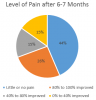
Consider thefollowing statistics from The Divided Mind: (179-183). They describe a retrospective study of Dr. Sarno's carefully pre-screened patients from 1999.
What about the 56% of people who don't have "little or now pain" or the 30% of people who have more than 20% of their pain? One could assume that they simply failed to heal themselves by not accepting the diagnosis fully or not doing the difficult work. I'm sure that that is the story for some of them, but for many of them, my bet is that the pain was a very strong motivator and that they were willing to do whatever they could to get rid of it. Seeing Dr. Sarno was very expensive, and people wouldn't do that unless they were serious.
Maybe a certain amount of TMS symptoms are just part of life. Certainly, if you look deeper, you'll see that even among many of our most amazing success stories, they accept an occasional ache and pain as just a natural part of life.
If anyone does try systematically looking through the success stories subforum to get an idea of what works, please let us know what you find!
http://www.tmswiki.org/forum/forums/success-stories-subforum.27/
The hard part is distinguishing between techniques that people used while healing and the techniques that actually caused the healing. For example, people may have grimaced a lot while healing, but we shouldn't presume that grimacing leads to healing. That is just
correlation, not causality.