-
Alan has completed the new Pain Recovery Program. To read or share it, use this updated link: https://www.tmswiki.org/forum/painrecovery/
You are using an out of date browser. It may not display this or other websites correctly.
You should upgrade or use an alternative browser.
You should upgrade or use an alternative browser.
EFT Tapping away pain
- Thread starter mike2014
- Start date

Eric "Herbie" Watson
Beloved Grand Eagle
Tapping can and will bring repressions to your conscious mind after you get used to it. The more you tap the more repressions will seem to arise that you never thought of, also while journaling your stressors you can choose to tap those away too.
There is another reason I used to love to tap, it showed me eventually that I was in control of my brain and not the other way around.
I would assume um stands for under mouth or you could just say chin,
Tapping is usually above eye, or ae. Side of eye or se. Under eye or ue. Under nose or un. And so forth, different practitioners sometimes make up their own names for the same spots. The top of the head is also an awesome place to tap. Although their are hundreds of places to tap like above the knee caps a little when you are tensed or stressed and want to relieve that tension.
There is another reason I used to love to tap, it showed me eventually that I was in control of my brain and not the other way around.
I would assume um stands for under mouth or you could just say chin,
Tapping is usually above eye, or ae. Side of eye or se. Under eye or ue. Under nose or un. And so forth, different practitioners sometimes make up their own names for the same spots. The top of the head is also an awesome place to tap. Although their are hundreds of places to tap like above the knee caps a little when you are tensed or stressed and want to relieve that tension.
Last edited:

Boston Redsox
Well Known Member
Mike
In my opinion it's just a distraction
In my opinion it's just a distraction

Forest
Beloved Grand Eagle
Below I'll post some notes I copied from the Kindle version of Nick Ortner's The Tapping Solution.
I totally agree, @Boston Redsox, that the whole "Meridian" thing in EFT is quite woo-woo. However, distraction can be a powerful effect to help you sit with an emotion without it being overwhelming. And if including a little bit of woo-woo placebo makes it work more helpful for some people so much the better.
Many people find it a safe and relaxing way to explore and eventually diffuse distressing emotions. I'd agree that the tapping is more or less just a distraction, but if it helps people get over their issues, why not?
The question is, does it actually help people? Well, there is some impressive scientific evidence that suggests it does.
Specifically, there is an article in a respected professional journal that reviews the scientific studies and claims that EFT meets a high bar for having scientific evidence to show that it helps.
The article is in Review of General Psychology, which is sponsored by the American Psychological Association, one of the most prestigious groups out there. It's a review article, which means that it systematically reviews the scientific evidence on a given subject. In particular, it assesses whether there is evidence to support the claim that "Accupoint Tapping" (e.g. EFT) actually helps people. Specifically, it asks whether the evidence that tapping works meets established criteria that would make tapping an "Evidence Based" treatment.
They conclude that:
I was pretty skeptical about EFT for a long time because it seemed so weird with all of it's talk of meridians. There is still no evidence to support the idea that meridians are real, and they sure look like something left over from a pre-scientific culture. I really don't believe in them.
But even if the only thing that the tapping provides is distraction, apparently that's enough. Because the practice seems to work pretty well.
(I say "seems to work" because this is just one review article and it is a very controversial article at that. Yet, if they got this far, that's pretty impressive.)
Here's a link to the article if anyone wants to take a look.
https://innersource.net/ep/images/stories/downloads/Acupoint_Stimulation_Research_Review.pdf
I have a pretty strong background in research and would be happy to answer any questions if people have them.
F
Here are the notes from The Tapping soltuion.
Tapping Pre
1. Choose your “Most Pressing Issue” (MPI) and devise a reminder phrase (see pages 16 and 20).
MPI is specific: "I feel this anger in my chest at my boss for telling me I'm not doing my job well enough."
Reminder phrase is short - just a couple of words that bring to mind your MPI. You’re repeating the reminder phrase out loud to remind yourself of the issue at each point. This reminder phrase serves to keep your focus on the MPI so you don’t get distracted. It also acts as a barometer, helping you determine along the way how true the MPI feels to you. \\ Once you get used to tapping, you can change your reminder phrase as you tap through each point. For example, you might say, “This anger … this red-hot anger … it’s burning in my chest … am so angry …” I will offer this kind of evolving reminder phrase in the tapping scripts throughout the book. But to start with, keep it simple and say the same statement at each point.
2. Rate the intensity of your MPI on the 0-to-10 Subjective Units of Distress Scale (SUDS; see page 18). Think about your MPI and notice what it brings up in your body. What level of distress does it bring up for you.
3. Craft a setup statement (see page 18). Even though [fill in MPI], I deeply and completely accept myself. Whatever your MPI is, just fill in the blank.
4. With four fingers on one hand, tap the Karate Chop point on your other hand while repeating your setup statement three times. Take a deep breath.
5. Tap through the eight points in the EFT sequence (see page 21) while saying your reminder phrase out loud. 5-7 times. Firm but gentle, like drumming on the side of desk. Two fingers for small areas, four for big. The tapping order begins at the top and works down. You can end by returning to the top of the head, to complete the loop.
Tapping main
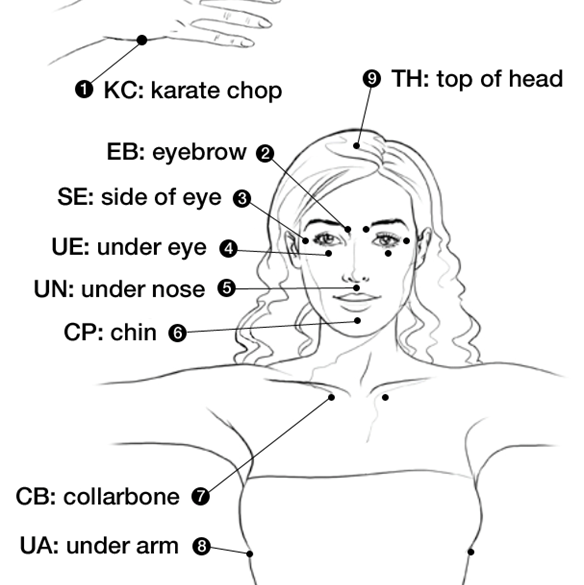
Head (TH) 4 fingers
Eyebrow (EB) 2 fingers - The inner edges of the eyebrows, closest to the bridge of the nose. Use two fingers.
Side of eye (SE) 2 - The hard area between the eye and the temple. Use two fingers. Feel out this area gently so you don’t poke yourself in the eye!
Under eye (UE) 2 - The hard area under the eye, that merges with the cheekbone. Use two fingers, in line beneath the pupil.
Under nose (UN) 2 - The point centered between the bottom of the nose and the upper lip. Use two fingers.
Chin (CP) 2 - This point is right beneath the previous one, and is centered between the bottom of the lower lip and the chin.
Collarbone (CB) 4 - Tap just below the hard ridge of your collarbone with four fingers.
Underarm (UA) 4 - On your side, about four inches beneath the armpit. Use four fingers.
Head (TH) 4 - And back where you started, to complete the sequence.
Now take another deep breath!
Tapping Post
· If your anxiety is still higher than “2”, you can do another round of tapping. Keep tapping until the anxiety is gone. You can change your set up statement to take into account your efforts to fix the problem, and your desire for continued progress. “Even though I have some remaining anxiety, I deeply and completely accept myself.” “Even though I’m still a little worried about this interview, I deeply and completely accept myself.” And so on.
6. Once you have finished tapping the eight points in the sequence, take a deep breath.
7. Again rate the intensity of your issue using the 0-to-10 scale to check your progress.
8. Repeat as necessary to get the relief you desire. Now that you’ve focused on dispelling your immediate anxiety, you can work on installing some positive feelings instead.
I totally agree, @Boston Redsox, that the whole "Meridian" thing in EFT is quite woo-woo. However, distraction can be a powerful effect to help you sit with an emotion without it being overwhelming. And if including a little bit of woo-woo placebo makes it work more helpful for some people so much the better.
Many people find it a safe and relaxing way to explore and eventually diffuse distressing emotions. I'd agree that the tapping is more or less just a distraction, but if it helps people get over their issues, why not?
The question is, does it actually help people? Well, there is some impressive scientific evidence that suggests it does.
Specifically, there is an article in a respected professional journal that reviews the scientific studies and claims that EFT meets a high bar for having scientific evidence to show that it helps.
The article is in Review of General Psychology, which is sponsored by the American Psychological Association, one of the most prestigious groups out there. It's a review article, which means that it systematically reviews the scientific evidence on a given subject. In particular, it assesses whether there is evidence to support the claim that "Accupoint Tapping" (e.g. EFT) actually helps people. Specifically, it asks whether the evidence that tapping works meets established criteria that would make tapping an "Evidence Based" treatment.
They conclude that:
clinical conditions for which acupoint stimulation protocols appear — based on the studies presented above — to meet the criteria for designation a s a “well - established treatment ” include phobias (Wells, et al., 2003; Salas, Brooks, & Rowe, 201 1) and test - taking anxiety ( Rubino, in press; Sezgin & Özcan, 2009 ) . Acupoint protocols appear to meet the criteria for designation as a “probably efficacious treatment ” for PTSD ( Church et al., 2011 ; Church, Hawk et al., in press; Connolly and Sakai, 2011 ; Karatzias et al., 2011 ) , depression (Brattberg, 2008; Church , De Asis, et al., in press; Karatzias et al., 2011), and public speaking anxiety ( Schoninger an d Hartung, 2010; Jones, Th ornton, & Andrews, 2011 ) .
It's pretty amazing. Finding that paper really changed my opinion on EFT.
I was pretty skeptical about EFT for a long time because it seemed so weird with all of it's talk of meridians. There is still no evidence to support the idea that meridians are real, and they sure look like something left over from a pre-scientific culture. I really don't believe in them.
But even if the only thing that the tapping provides is distraction, apparently that's enough. Because the practice seems to work pretty well.
(I say "seems to work" because this is just one review article and it is a very controversial article at that. Yet, if they got this far, that's pretty impressive.)
Here's a link to the article if anyone wants to take a look.
https://innersource.net/ep/images/stories/downloads/Acupoint_Stimulation_Research_Review.pdf
I have a pretty strong background in research and would be happy to answer any questions if people have them.
F
Here are the notes from The Tapping soltuion.
Tapping Pre
1. Choose your “Most Pressing Issue” (MPI) and devise a reminder phrase (see pages 16 and 20).
MPI is specific: "I feel this anger in my chest at my boss for telling me I'm not doing my job well enough."
Reminder phrase is short - just a couple of words that bring to mind your MPI. You’re repeating the reminder phrase out loud to remind yourself of the issue at each point. This reminder phrase serves to keep your focus on the MPI so you don’t get distracted. It also acts as a barometer, helping you determine along the way how true the MPI feels to you. \\ Once you get used to tapping, you can change your reminder phrase as you tap through each point. For example, you might say, “This anger … this red-hot anger … it’s burning in my chest … am so angry …” I will offer this kind of evolving reminder phrase in the tapping scripts throughout the book. But to start with, keep it simple and say the same statement at each point.
2. Rate the intensity of your MPI on the 0-to-10 Subjective Units of Distress Scale (SUDS; see page 18). Think about your MPI and notice what it brings up in your body. What level of distress does it bring up for you.
3. Craft a setup statement (see page 18). Even though [fill in MPI], I deeply and completely accept myself. Whatever your MPI is, just fill in the blank.
4. With four fingers on one hand, tap the Karate Chop point on your other hand while repeating your setup statement three times. Take a deep breath.
5. Tap through the eight points in the EFT sequence (see page 21) while saying your reminder phrase out loud. 5-7 times. Firm but gentle, like drumming on the side of desk. Two fingers for small areas, four for big. The tapping order begins at the top and works down. You can end by returning to the top of the head, to complete the loop.
Tapping main
Head (TH) 4 fingers
Eyebrow (EB) 2 fingers - The inner edges of the eyebrows, closest to the bridge of the nose. Use two fingers.
Side of eye (SE) 2 - The hard area between the eye and the temple. Use two fingers. Feel out this area gently so you don’t poke yourself in the eye!
Under eye (UE) 2 - The hard area under the eye, that merges with the cheekbone. Use two fingers, in line beneath the pupil.
Under nose (UN) 2 - The point centered between the bottom of the nose and the upper lip. Use two fingers.
Chin (CP) 2 - This point is right beneath the previous one, and is centered between the bottom of the lower lip and the chin.
Collarbone (CB) 4 - Tap just below the hard ridge of your collarbone with four fingers.
Underarm (UA) 4 - On your side, about four inches beneath the armpit. Use four fingers.
Head (TH) 4 - And back where you started, to complete the sequence.
Now take another deep breath!
Tapping Post
· If your anxiety is still higher than “2”, you can do another round of tapping. Keep tapping until the anxiety is gone. You can change your set up statement to take into account your efforts to fix the problem, and your desire for continued progress. “Even though I have some remaining anxiety, I deeply and completely accept myself.” “Even though I’m still a little worried about this interview, I deeply and completely accept myself.” And so on.
6. Once you have finished tapping the eight points in the sequence, take a deep breath.
7. Again rate the intensity of your issue using the 0-to-10 scale to check your progress.
8. Repeat as necessary to get the relief you desire. Now that you’ve focused on dispelling your immediate anxiety, you can work on installing some positive feelings instead.
Eric "Herbie" Watson
Beloved Grand Eagle
Great article, and great find on EFT tapping forest. Nick Ortner and his sister both have had lots of success in their tapping solution books and world summits.
Boston Redsox
Well Known Member
To each is own I find the lord prayer very helpful...
The sitting still part I can understand even saying the mantras but the tapping I find it to be a major distraction. But to each his own and if it helps or works more power to you .
The sitting still part I can understand even saying the mantras but the tapping I find it to be a major distraction. But to each his own and if it helps or works more power to you .
Forest
Beloved Grand Eagle
Yeah, I agree about the tapping being distracting. But I actually think that that is the point. I think that the tapping gives you something else to think about while you explore powerful or traumatic emotions. The distraction helps you keep some distance between yourself and the emotions.
(trigger warning - rape)
You can imagine how in that type of exposure therapy, having some distracting tapping might be a good thing. That's really how I think of EFT. It's basically at-home exposure therapy with some distraction and some new-agey placebo effect. I would imagine that it's particularly good for someone who has a strong negative emotion that they want to let go of.
I actually haven't used it much myself, but try to keep up on it because I've been running this site for 7 years and I want to make sure I give good advice. The paper I mentioned above provides scientific evidence that the tapping helps people with various psychological issues. Nick Ortner's books are selling extremely well and one of his books is specifically about using tapping for pain:
http://www.novelrank.com/user/forestfortreestms
I'd like the people who are using tapping for pain to find this site so that they can find that tapping is just part of a larger TMS approach.
My personal philosophy is that TMS healing is about soothing the mind first. TMSers are often all tied up in knots, and if we can untie those knots and get our heads in the right place, free from fear and accepting who we are, I figure that might be the best thing we can do for TMS healing.
Generally,
(trigger warning - rape)
For example, suppose someone has a powerful trauma that is haunting them and bringing up powerful emotions. Suppose that they want to clear up those emotions. One treatment approach is called exposure therapy. Here's a CBS news story that tells how exposure therapy can help teens who have been raped.
http://www.cbsnews.com/news/making-...ma-through-exposure-therapy-works-study-says/
The exposure therapy just refers to people being exposed to the powerful feelings again and again, in a safe environment, so that those feelings die down.
http://www.cbsnews.com/news/making-...ma-through-exposure-therapy-works-study-says/
The exposure therapy just refers to people being exposed to the powerful feelings again and again, in a safe environment, so that those feelings die down.
You can imagine how in that type of exposure therapy, having some distracting tapping might be a good thing. That's really how I think of EFT. It's basically at-home exposure therapy with some distraction and some new-agey placebo effect. I would imagine that it's particularly good for someone who has a strong negative emotion that they want to let go of.
I actually haven't used it much myself, but try to keep up on it because I've been running this site for 7 years and I want to make sure I give good advice. The paper I mentioned above provides scientific evidence that the tapping helps people with various psychological issues. Nick Ortner's books are selling extremely well and one of his books is specifically about using tapping for pain:
http://www.novelrank.com/user/forestfortreestms
I'd like the people who are using tapping for pain to find this site so that they can find that tapping is just part of a larger TMS approach.
My personal philosophy is that TMS healing is about soothing the mind first. TMSers are often all tied up in knots, and if we can untie those knots and get our heads in the right place, free from fear and accepting who we are, I figure that might be the best thing we can do for TMS healing.
Generally,
- if someone is all riled up and they want to cool down in the moment, I think that deep breathing or meditation is the best approach.
- if someone wants to better understand what they are really feeling so they can better think psychologically and just be happier, I think mindfulness is great
- if someone has a really strong emotion such as anger or anxiety, tapping might be a good approach.
- exercise, self compassion, getting out, finding things that bring you joy, and social relationships are pretty much great for everyone.

North Star
Beloved Grand Eagle
Forest, I really appreciate your thoughts on this. I've been a skeptic of it as well and well, little ole cynical me sees the Ortners have built quite the empire out of tapping. BUT ----- I try to keep my attack dogs under control and realize there's a lot of people who swear by the efficacy. I also know that Dr. Schubiner uses some acupressure/mantra techniques to help reprogram the brain.
I tried it faithfully for a month and my conclusion was that it was helpful in that I was giving voice to my honest feelings and releasing them. And I also try to live with an appreciation of mystery and respect for things that can't be quantified tangibly.
And like you conclude - if it is helping folks, it's fabulous to be able to recommend another tool.
I tried it faithfully for a month and my conclusion was that it was helpful in that I was giving voice to my honest feelings and releasing them. And I also try to live with an appreciation of mystery and respect for things that can't be quantified tangibly.
And like you conclude - if it is helping folks, it's fabulous to be able to recommend another tool.