• Alan has completed the new Pain Recovery Program. To read or share it, use this updated link: https://www.tmswiki.org/forum/painrecovery/
  • Welcome to the new TMS Wiki server! Things aren't finished yet: email is not set up, so notification and password-reset emails don't go out, and new registrations are paused until email is installed. Details and updates are in this thread (click here). Locked out? Email tmswikisignups@gmail.com from the address where you receive TMS Wiki notifications.

Day 5 Day 5

StarStuff

Peer Supporter
Much of the sensations I felt on Day 4 have subsided so I decided to continue onto Day 5. I still feel reluctant to uncover these emotions which is interesting considering they’re not even repressed. I’m aware of the childhood and young adult trauma I experienced, but I never specifically labeled it.

I can now see what particularly makes me angry, sad, scared and resistant. There is one situation from my childhood, being left home alone to care for myself on sick days, that is a real driving factor of my current situation. I’m not sick now but I’ve felt sick for a while and I’m again home alone, without a support system. I think there’s anger there with feeling abandoned but also sadness that I didn’t get the care I need. It’s like I’ve come full circle and the child in me that was angry and sad then is like “why are you letting this happen again?”

I’m not sure what to do with this now, but the therapist I contacted yesterday put me on a wait list so I’m hoping to get in there soon to figure it out.
 
I still feel reluctant to uncover these emotions which is interesting considering they’re not even repressed

I’ve begun to realize that even though the emotions and the memory does not seem repressed (since i can remember the event clearly) when i work with my psychotherapist with the memory a lot of intense body sensations come up. There is “stuff” there that may not be repressed but rather unprocessed. Either because there was too much intensity to process it all at the time or i did not have the language or understanding to process and it became lodged in my body. The book “the body keeps the score” was vvery helpful for understands this dynamic.
 
I still feel reluctant to uncover these emotions which is interesting considering they’re not even repressed

I’ve begun to realize that even though the emotions and the memory does not seem repressed (since i can remember the event clearly) when i work with my psychotherapist with the memory a lot of intense body sensations come up. There is “stuff” there that may not be repressed but rather unprocessed. Either because there was too much intensity to process it all at the time or i did not have the language or understanding to process and it became lodged in my body. The book “the body keeps the score” was vvery helpful for understands this dynamic.

Thank you for mentioning it because that’s exactly what it is. It’s unprocessed and having to do that is very difficult. It is often too intense and I’d rather forget about it. But I guess that’s what causes TMS so I have to deal with it.

My new therapist just suggested I read that book and I gave it a try but the very overly detailed stories of abuse and violence is something I don’t like to read. I don’t even watch violent films or tv. I just ordered a book called “Feeling Good” that was suggested and I’m praying it doesn’t have any graphic stories in it.
 
. I still feel reluctant to uncover these emotions which is interesting considering they’re not even repressed
As @Volcano1963 indicates, there are levels that go deeper than just awareness of things that happened. Very few people are so repressed that they are completely unaware of the circumstances of their trauma (infants excepted, maybe). Like you, most adults of childhood trauma have memories they can access, but they don't know how to get beyond surface anger over what happened to them.

The real repression is about the terrifying threat to survival which is experienced by anyone who is left unprotected and exposed to their own vulnerability in the face of physical danger, isolation, and/or abandonment. Facing that vulnerability and the associated rage of, for example, being abandoned by a parent who you desperately wanted to stay with you, who should have been nurturing and protecting you, is the kind of emotional awareness that makes most people so uncomfortable that they resist "going there". Instead they hang out in the shallows of anger, obsessing over details and ruminating about "what-ifs", often making justifications for the experiences and often blaming themselves - without understanding that this is not going to lead to freedom.

The key to accessing vulnerability is to become the child having the experiences, and feel THOSE emotions. It will be very uncomfortable because the child is immature and selfish and irrational. These characteristics evolved to give the child incentive to fit in with the community, which was essential to survival. Today's family units are quite isolated by comparison, and in a family with a dysfunctional parent or parents, the child may end up with coping skills that are equally dysfunctional, usually involving the repression of those naturally selfish and irrational behaviors, and replacing them with fear/avoidance and people-pleasing behaviors.

new therapist just suggested I read that book and I gave it a try but the very overly detailed stories of abuse and violence is something I don’t like to read. I don’t even watch violent films or tv. I just ordered a book called “Feeling Good” that was suggested and I’m praying it doesn’t have any graphic stories in it.
Perfect example of a fear/avoidance coping strategy. Put this on your list of things to examine in depth. It is neither healthy nor productive,

You're doing good work, StarStuff. To really progress, I feel like you will need to take some risks. Therapy can really help support that, and we will be here to do what we can.
 
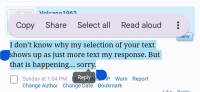
I don’t know why my selection of your text shows up as just more text my response. But that is happening… sorry.
Hey, @Volcano1963, I took a screenshot of what it should look like when you highlight a section of text by someone. You need to click on the black balloon which says "Reply". I have found that it sometimes doesn't show up (esp on my phone) in which case you have to ignore the Copy etc commands, dismiss the highlight, and try again. Also on my latest phone, I am completely unable to get a response from clicking on the black Reply balloon unless I zoom in on the text to enlarge it, it's very annoying (Pixel 9a).

If all else fails, you can always copy & paste, then put quotes around the text or else italicize it! That works fine, but the Reply balloon feature is supposed to be easier.

I, for one, appreciate users like you who prefer to use partial quotes instead of using the regular menu Reply to repeat entire lengthy posts, which is quite pointless :p
 

Attachments

  • Screenshot_20260602-173747.png
    Screenshot_20260602-173747.png
    149.6 KB · Views: 30
As @Volcano1963 indicates, there are levels that go deeper than just awareness of things that happened. Very few people are so repressed that they are completely unaware of the circumstances of their trauma (infants excepted, maybe). Like you, most adults of childhood trauma have memories they can access, but they don't know how to get beyond surface anger over what happened to them.

The real repression is about the terrifying threat to survival which is experienced by anyone who is left unprotected and exposed to their own vulnerability in the face of physical danger, isolation, and/or abandonment. Facing that vulnerability and the associated rage of, for example, being abandoned by a parent who you desperately wanted to stay with you, who should have been nurturing and protecting you, is the kind of emotional awareness that makes most people so uncomfortable that they resist "going there". Instead they hang out in the shallows of anger, obsessing over details and ruminating about "what-ifs", often making justifications for the experiences and often blaming themselves - without understanding that this is not going to lead to freedom.

The key to accessing vulnerability is to become the child having the experiences, and feel THOSE emotions. It will be very uncomfortable because the child is immature and selfish and irrational. These characteristics evolved to give the child incentive to fit in with the community, which was essential to survival. Today's family units are quite isolated by comparison, and in a family with a dysfunctional parent or parents, the child may end up with coping skills that are equally dysfunctional, usually involving the repression of those naturally selfish and irrational behaviors, and replacing them with fear/avoidance and people-pleasing behaviors.


Perfect example of a fear/avoidance coping strategy. Put this on your list of things to examine in depth. It is neither healthy nor productive,

You're doing good work, StarStuff. To really progress, I feel like you will need to take some risks. Therapy can really help support that, and we will be here to do what we can.

Thank you so much! I’ve been trying to do inner child stuff but I find it difficult. Like I can remember what happened but I can’t feel the rage. I know I’m angry that I wasn’t nurtured but I don’t feel angry. I have a long way to go.

I never considered my aversion for violent and upsetting entertainment as a fear/avoidance coping strategy but it is. I’m terrified of panic attacks and so the therapy I did previously directed me to stop engaging in anything disturbing. So I’ll have to figure out how to navigate that without letting what I’m exposed to become an OCD feedback loop in my mind.

Part of not being nurtured as a child was not being protected from inappropriate content on tv, in magazines or from adult conversations. I watched, saw and heard more than a child should have. So I think I was trying to re-parent myself to give my mind a chance to have some innocence and maybe disrupt the feedback loop that created so much anxiety.

I’m still not gonna read that book though. :D I did experience abuse but not sexually and reading explicit details about what happened to the kids and women in those stories borders on inappropriate from my point of view. I don’t know if that part is avoidance or just not wanting to read explicit sexual assault details which is just a choice. Some things can’t be unseen and even Dr. Sarno said what were exposed to stays in our minds forever. I know bad stuff happens and I don’t need it spelled out so explicitly. :arghh:
 
As @Volcano1963

You're doing good work, StarStuff. To really progress, I feel like you will need to take some risks. Therapy can really help support that, and we will be here to do what we can.

Thank you for everything you said and I appreciate that you are all there to help. I’m so grateful I started this program.
 
Some things can’t be unseen and even Dr. Sarno said what were exposed to stays in our minds forever. I know bad stuff happens and I don’t need it spelled out so explicitly. :arghh:
I get it. When traumatic memories feel unsafe, it's going to be pointless, at best, to keep trying to access them through things like self-directed journaling - it might make you believe you're accomplishing something when you're still just paddling around in the shallow end of the pool - this is just the kind of distracting activity that the TMS brain loves. At worst, it could cause a setback that is difficult to recover from or possibly even be emotionally damaging to someone with serious abuse. This is territory that can hopefully be safely explored with a skilled therapist.

It might be interesting, and possibly? less threatening, to stop making lists from the past, and instead examine the resistance and the avoidance behavior itself, and how it manifests in your life right now. Just a thought.
 
It might be interesting, and possibly? less threatening, to stop making lists from the past, and instead examine the resistance and the avoidance behavior itself, and how it manifests in your life right now. Just a thought.

I agree that examining the resistance and avoidance behavior is a good idea. I know I do a lot of that. I’ve also been resistant to journaling so I think it’s a good thing I’ve started it. I just had my first CBT appointment and they asked about avoidant behavior so I think we’re going to make that a focal point. They’re also willing to do exposure therapy with me so that’s going to help a lot as I haven’t had a support system for it which tends to make resistance stronger.
 
I, for one, appreciate users like you who prefer to use partial quotes instead of using the regular menu Reply to repeat entire lengthy posts, which is quite pointless

I didn’t realize the other way annoyed anyone. :shy:But I’m new so I hope I’m forgiven. :) Now I know how to use partial quotes so thank you.
 
I hope I’m forgiven
But of course!
As a relatively new member (but not totally new) i watch myself picking up these little tips and tricks for using the wiki and notice that it’s just another indicator of engagement (more wiki features are discovered as you go along) sort of how the profile identifies us by our different tiers (peer supporter to beloved grand eagle and beyond to coach?).
I like discovering the wiki functions and am awed by the wealth of resources within the wiki. The other day i discovered i can go to people’s pages and read their posts and who they are following and followed by. So many inspiring stories and treasure troves of wisdom and experience to ponder upon.
 
Back
Top