Bringing back Is 'catastrophising' part of the TMS personality?

dabatross

Well known member
This was a post on the old TMSwiki forum that really struck me especially this what Forest said:

"I've been wondering about how fear of future pain can worsen TMS, leading to a vicious cycle recently. It seems like a mindfulness approach of acknowledging the fear and allowing yourself to feel it before letting it go may work better. This approach is often discussed among meditators, and managing fear like this is really quite close to what is done in meditation with managing intrusive thoughts. For anyone who wants to read more about it, I can recommend "8 Minute Meditation" as a very quick read and easy to digest intro."

I bought the book 8 minute meditation and I love it extremely easy to read, the guy is really down to earth, and is the first time I've actually started doing meditation because I understood what it was about. I read a book called "Natural Pain Relief" by Shinzen Young and it was just too difficult for me to understand.

Anyhow there is one central theme here to mindfulness, meditation, and that book I talk about Dissolving Pain that I'm reading. They all tell you not to fight feelings of fear, pain, negativity, etc but to feel them fully and let them pass on their own. As you said Forest "acknowledging the fear and allowing yourself to feel it before letting go" seems to be the key to these methods.

The Dissolving Pain book refers to it like this:

"One of the reasons we are so attached to narrow-objective focus is that it successfully represses the pain, at least in the short run. And we would keep directing our attention away from our pain if it didn't eventually surface into conscious awareness. Sometimes however the pain is more stubborn and our resistance to it is greater. At this point, we need to do the opposite of what our instincts usually tell us to do. In response to pain, our habit is to distance ourselves from the pain and to fight it, thinking that if we don't resist the pain it will intensify. But over the long term, exactly the reverse is true. We exacerbate the pain by narrow-focusing away from it or otherwise trying to resist it, consciously or unconsciously. After we open our attention into a diffuse awareness, we need to learn to move toward the pain, allowing it to melt into broadened awareness, and so let it dissolve."

Pretty much the same concept as the meditation just a different method of doing it. All of the reading I've done says this "A cranked up nervous system that is on full alert due to stress, fear, anxiety, and other negative emotions makes you hypersensitive to pain."

I dont know about you guys but I think the main driving force behind my pain is the fear of it which I believe heightens my arousal and sensitivity to pain and creates a viscous circle. Doing journaling Im becoming more aware of how much stuff I actually fear and its pretty surprising. As Brady said in his book, I'm in the "fear prone personality" where I think the worst of situations, try to calculate the future and prevent things from happening that might cause me more pain, worry way too much about nothing, etc.
 
. At this point, we need to do the opposite of what our instincts usually tell us to do. In response to pain, our habit is to distance ourselves from the pain and to fight it, thinking that if we don't resist the pain it will intensify. But over the long term, exactly the reverse is true.... ...After we open our attention into a diffuse awareness, we need to learn to move toward the pain, allowing it to melt into broadened awareness, and so let it dissolve."

Thanks for posting this, databatross - this is helpful in understanding the dynamics of things that seem to work in the short run and why they don't last. This is very complex stuff! I also like this one:

not to fight feelings of fear, pain, negativity, etc but to feel them fully and let them pass on their own

And I think it is similar to what Claire Weekes says in Hope & Help for Your Nerves, when she describes the four steps to conquering panic, which are: Facing, Accepting, Floating Through, and Letting Time Pass.

I especially loved the floating through.

In my case, Dr. Sarno gave me the awareness, but it was these four steps from Claire Weekes which really allowed me to recover, because anxiety was such a huge issue for me.

So I'm totally with you - I think this is a vital key to recovery.

Jan
 
This was a post on the old TMSwiki forum that really struck me especially this what Forest said:

"I've been wondering about how fear of future pain can worsen TMS, leading to a vicious cycle recently. It seems like a mindfulness approach of acknowledging the fear and allowing yourself to feel it before letting it go may work better. This approach is often discussed among meditators, and managing fear like this is really quite close to what is done in meditation with managing intrusive thoughts.

This sounds so easy - yet in credibly scary to me since I too suffer anxiety. I wonder if this book would help me with my meditation? I need something new to kick start my program right now, and perhaps this is a key. Sounds so easy in writing, but wonder if I could actually pull it off?

They all tell you not to fight feelings of fear, pain, negativity, etc but to feel them fully and let them pass on their own. As you said Forest "acknowledging the fear and allowing yourself to feel it before letting go" seems to be the key to these methods.

Again - very logical and I still feel fear about facing fear. I really let myself go out there when I get into fear, maybe that's why.

But over the long term, exactly the reverse is true. We exacerbate the pain by narrow-focusing away from it or otherwise trying to resist it, consciously or unconsciously. After we open our attention into a diffuse awareness, we need to learn to move toward the pain, allowing it to melt into broadened awareness, and so let it dissolve."

But anxiety is "flight or fright". So I am slightly confused as to how this would work. It clearly says to "not fight it". So perhaps what this is asking is for: acceptance. Stop the flight AND the fight. Acceptance. Interesting. I hadn't thought of my pain in this way. I'm always trying to avoid it or the FEAR of avoiding it.

Pretty much the same concept as the meditation just a different method of doing it. All of the reading I've done says this "A cranked up nervous system that is on full alert due to stress, fear, anxiety, and other negative emotions makes you hypersensitive to pain."

And this is my little brain on steroids. I am a cranked up nervous system and I do the above.

Maybe it's time to get into more meditation.....

I dont know about you guys but I think the main driving force behind my pain is the fear of it which I believe heightens my arousal and sensitivity to pain and creates a viscous circle.

Mine too. I like this a lot dabatross. It's bringing up new ideas which I hadn't thought of and/or putting them in a new way than the programs I've worked did not. Thank you for posting this. I think we can all say the same things in different ways - but still one person may benefit from it when looked at from a new perspective.

BG
 
No problem guys I like to create the discussion on here about the stuff Im reading to see if you have any insights. The reason I think this technique works is because I've had pains in the past that lasted for a few months and then they just disapeared. I went through the whole gamut of treatments for it too and it was when I stopped caring about it and worrying about it that the pain went away. This was 3-4 months of pain that I was worried about and then for some reason I just stopped caring. I dont know why I dont remember how it happened but something else came up that was more important in my mind and the pain vanished. It was actually my wrist that was the problem. When I first started working on computers when I got the eystrain I eventually stumbled upon websites that talked about other "ergonomic issues" associated with computers as well. Then I started exhibiting these symptoms and they lasted for a few months. I went through the whole shebang of treatments like I said of first changing computer ergonomics, then using wrist braces, changing keyboards and mice, to the point where I was wearing a wrist brace full time. One day I took off the wrist brace and didn't care about it anymore and I haven't had the pain since. So I think it was my resistance to the pain and my trying to fix it that perpetuated it.. it sounds like an oxymoron but I think its the truth. Its the worrying and fear over the pain that keeps it going but thats also one of the hardest parts to get over.
 
Dabatross,

"I've been wondering about how fear of future pain can worsen TMS, leading to a vicious cycle recently. It
seems like a mindfulness approach of acknowledging the fear and allowing yourself to feel it before letting it go may work better."

I totally agree. Meditation and mindfullness have lead me to this path as well. I find it works wonderfully. I believe you need to process it (release it, whatever). Sometimes, the simple act of observing it, without judgement is sufficient. Frequently when I observe a physical sensation, I also get an image: Mom, Dad, sister, etc. which then clues me into what "button" is being pushed and I can choose how I respond, vs reacting.

I see it like this. You have an in box and an out box on your "desk" (read: mind/body). Each emotion goes in the in box (at this point you do have a physical sensation. An emotion is ALWAYS followed by an immediate sensation [see "Healing Trauma", Peter Levine]. It may be very subtle though). If you "take it out" and "process it", you can then put it in the out box. If not, the inbox fills up. When it tips over, you have a significant distracting reaction.

Now, with being mindful and combining this with Peter Levine's Somatic Experiencing and felt sense, I notice when the item goes into the in box immediatly. Then, i can process it now and not let them build up. It takes lots of practice (I have been practicing this since the end of 2008). But this is my practice now....and forever. It is my journey and I am loving every minute of not being in severe pain, having ulcers, or any other significantly distracting symptoms.

Matthew
 
Catastrophising is such a major part of what fuels TMS that I thought it would be helpful to bring back some of the other posts in this thread that were first posted on our old forum. Feel free to respond to anything mentioned in this thread. I would love to continue this discussion on how catastrophising fuels TMS.

flutterby2 said:
Unfortunately I was only able to dip in and out of watching the Live Panel yesterday so maybe my questions will have been answered already. But even if ithey were, maybe it will be useful to repeat them here for those who were unable to attend.

Is the tendency to 'What if?' thinking a trait of a TMS personality?

It cropped up in the 'chat' yesterday and it does seem to arise on TMS forums quite often. eg what if I never get better? what if I really have some serious problem that nobody has diagnosed? what if there's some deep psychological issue I haven't uncovered? etc etc etc....

If so, did the people who told their success stories encounter this and how did they deal with it?

Pandamonium09 said:
I'm sure all TMSers do What-Ifs, because they are fuelled by fear, and fear is what keeps TMS going.

But actually catastophising, I think that that has pessemistic feel to it, and i'm not a pessemist lol. So, no I would say I don't catastrophise.

Forest said:
This makes a lot of sense to me. I definitely feel like I catastrophize a lot and that it probably was a big part of my TMS.

I found the following very interesting quote in The Mindbody Prescription (pp.31-32):
"Fear is another important equivalent of pain that may be more effective than the pain itself to achieve the mind's goal of distracting attention from repressed rage. The *fear* of pain, physical activity, injury or spinal abnormality is enough to perpetuate TMS, even in the absence of pain. The mind is interested only in keeping our attention on the body; the fear of any of these phenomena will accomplish that as well as the reality of pain itself. This is why our therapeutic program requires not only the cessation of pain but the elimination of fear."

Beautifully said!

flutterby2 said:
Forest - I don't understand the sentence,

'The *fear* of pain, physical activity, injury or spinal abnormality is enough to perpetuate TMS, even in the absence of pain.'

I thought TMS produced the pain (or other symptoms) so how can TMS be perpetuated if there is no pain (or other symptoms'?

Peghanson said:
Great find Forest. It never ceases to amaze me that despite having read all of Sarno's book many times, it still helps me to re-read sections and the one you quoted is brilliant.

Flutterby--I think what he is saying is that FEAR of the pain (or any other symptom) can serve the same purpose as the actual pain. The fear keeps our attention, our focus, so that we are not thinking about our repressed emotions.

As far as catastrophising--Yes, that was certainly a big issue for me during my TMS and to a lesser extent even now. Now it's more like the "what if" situation. For example, if one of my kids is having trouble, sometimes I extrapolate into the future and make more of it than needed. My husband will remind me that right now that is not the case and it doesn't help to play the what it game.

flutterby2 said:
Ah, I see! Thank you. Peg. That did read a bit strangely to me but you have put it much better.

The 'Fear Factor' seems to be cropping up so frequently in various forms that I think it might be worth exploring in a separate thread at some point so that people who have overcome it can make suggestions to those who still struggle with it.

I can't remember, does Dr Sarno give any specific instructions about how to eliminate fear?

HilaryN123 said:
I think this comes under health anxiety (a particular form of anxiety) which has been discussed on the TMSHelp forum. ( "What if I have some terrible disease?" "What if I have cancer which the doctors haven't been able to detect?"))

flutterby2 said:
I think the 'what if' that came up in the Live Panel (and elsewhere) is slightly different - more a question of 'what if I'm in this much pain for the rest of my life?'

I would think that was a perfectly reasonable question and not necessarily to do with health anxiety, though it's not one I remember ever asking myself. I just wonder whether anyone who has been successful with the Sarno approach has struggled with this particular 'what if' and, if so, how they overcame it.

I'd imagine there are plenty of people who would appreciate some advice on this topic.

HilaryN123 said:
Whenever you find yourself doubting you'll get better, focus on your successes / improvements, however small.

Peghanson said:
I think the key to Hilary's response was the last part "however small"

My progress initially was very, very slow and I had lots of doubt and fear. Many, many, many times, I lost heart, became disappointed, discouraged and doubtful. When that happened, I would re-read the books, or watch the video or journal. I would also remind myself that I had experienced some improvement, "however small" it was and nothing else had worked as well. At times I beat myself up because I wasn't recovering perfectly. I felt like a failure at the TMS approach (these thing of course worsened my pain). It took consistency, reading, learning and support (tmshelpforum at the time-back in the old days- BW (before wikiville) to get the message deeply into my subconscious.

I guess if I had had absolutely NO improvements. If my pain had stayed at the severe level it was at. I continued to be debilitated and depressed about it all. Then I may have given it up. Maybe that would have meant that my problem wasn't TMS. But it just didn't make sense to me that someone like me could have chronic pain, yet seem pretty healthy.
I am new here. New to TMS too. But I have managed to, I believe, nearly rid myself of chronic urticaria - hives - just by reading online information on this site, just over the course of the past week! I just totally went for it, dropped the antihistamines, ate all my allergens, forced myself to go out and live life, cried my heart out over all I could dredge from my childhood and wrote it all down. Seems to have 85% cleared. Anyway when I saw this question about 'catastrophising' being part of the TMS personality, I just had to contribute. In my case, totally. I always jump ahead of events to look into the worst case senario in anything to do with health. Also I am fascinated by issues like climate change, peak oil, over population - all worse case scenarios, which scare me to bits but somehow I can't leave them alone! So this characteristic completely chimes with me...
It is no exaggeration when I say that my initial improvement was so slight as to be almost imperceptible. I am so very glad that I didn't give up on the mind body approach.

Forest said:
I've been wondering about how fear of future pain can worsen TMS, leading to a vicious cycle recently. It seems like a mindfulness approach of acknowledging the fear and allowing yourself to feel it before letting it go may work better. This approach is often discussed among meditators, and managing fear like this is really quite close to what is done in meditation with managing intrusive thoughts. For anyone who wants to read more about it, I can recommend "8 Minute Meditation" as a very quick read and easy to digest intro.

flutterby2 said:
Yes, I think that may be an important part of it.

I also think there are useful 'what ifs' and unhelpful ones. I read in 'The Positive Power of Negative Thinking' that some people habitually ask 'what if' in order to make sure they've 'covered all their bases'. That is useful and is called 'defensive pessimism' - as opposed to 'strategic optimism'. Neither approach is 'wrong' - just two different ways of approaching things.

But I think that 'defensive pessimism' can become a problem when the 'what if' is asked in relation to something over which we have no control. An example would be that I was asking recently 'what if no publishers are interested in my designs?' and that led me to formulate Plan B, self-publishing - ie it was useful, if not at all pleasant at the time! Whereas a friend worried herself sick for weeks in advance of her only son and youngest daughter flying to California together. Her 'what if' (ie what if the plane crashes and I lose both of them) was very understandable but as she had no control over whether the plane would crash (and no real control over whether they would travel together) it served no purpose. Ideally, I suppose, she needed to 'let go' - far easier said than done!

BTW, this is a quote from Albert Schweitzer:

'Pain is a more terrible lord of mankind than even death himself.'

Although this may ring true at times with some people, maybe those who have recovered from TMS would agree that our own power, if we know how to access and harness it, is actually greater?

andalucian said:
I am new here. New to TMS too. But I have managed to, I believe, nearly rid myself of chronic urticaria - hives - just by reading online information on this site, just over the course of the past week! I just totally went for it, dropped the antihistamines, ate all my allergens, forced myself to go out and live life, cried my heart out over all I could dredge from my childhood and wrote it all down. Seems to have 85% cleared. Anyway when I saw this question about 'catastrophising' being part of the TMS personality, I just had to contribute. In my case, totally. I always jump ahead of events to look into the worst case senario in anything to do with health. Also I am fascinated by issues like climate change, peak oil, over population - all worse case scenarios, which scare me to bits but somehow I can't leave them alone! So this characteristic completely chimes with me...

I don't mean I only read stuff on this site to help me identify and cure TMS symptoms - I obviously gleaned the internet for every bit of help I could since things had got desperate and I had to do something. I was falling apart with the pain and swelling and with kids and a baby to care for I just had to find an answer. Its been 3 days of ease now...at this point I'm confident it will last. If it does I am going to make such a big thing of drawing other hives sufferers to look into TMS; forums are full of their heartbreaking stories with no hope of relief, yet online it is quite hard to find the connection between urticaria and TMS. You have to know what you're looking for to get a TMS hit under searching under hives or urticaria.

Pandamonium09 said:
That's great news Andalucian, and welcome to the wiki community.
You are right, so many forums are full of people in pain just bringing each other down, but sadly not many of them are open minded enough to consider TMS.
Good luck with your journey,
Panda
 
I love the quote Hilary said, Whenever you find yourself doubting you'll get better, focus on your successes / improvements, however small.

Even if it doesn't seem like your progress has been enough, focusing on the smallest of successes will send a positive signal to your unconscious. And, if you think about, recovering is only a series of small successes built up over time.
 
I bought the book 8 minute meditation and I love it extremely easy to read, the guy is really down to earth, and is the first time I've actually started doing meditation because I understood what it was about.

Hi,
I loved the 8 minute meditation book. It is short, practical and it demystify the concept of secrecy and expensive meditation practices. I would recommend it to anyone that wants to learn meditation.
I learned transcendental meditation 20 years ago with a master (very expensive). He was very calm and soothing. I also participated in some groups. I kept meditating but this "transcendental" meditation became to religious for me. Meditation is helpful but I came to the conclusion that the real help for pain is going all the way back to our pain roots. We can do it through journaling, therapies, reading different books etc. You can even do it in meditation, feel the pain, locate it, relax it and find the uncomfortable emotional feeling that comes with it.
I am also learning about IFS (Internal Family Systems) and I integrate it in my meditation.
The book by John Lee "Facing the Fire" helped me a lot, because I never thought I was angry, He explains why we are angry from birth on.

Our subconscious inside world is tough. That is the most difficult part to discover, to free, to manage, to understand and to feel. Why did my subconscious decide to repress my feelings, my rage, my fears? Why did it happen to me and not to somebody else? When and why did I become numb to my feelings? How do I dig them out? Which one do I need to express? How do I express them? What events are pivotal to my recovery? When I try to go into my subconsciousness and heal, why is it fighting me back and not letting me heal? tough, tough. I am just hanging in there, learning, practicing, reading, and never giving up.

Leonor
 
Meditation is helpful but I came to the conclusion that the real help for pain is going all the way back to our pain roots. We can do it through journaling, therapies, reading different books etc. You can even do it in meditation, feel the pain, locate it, relax it and find the uncomfortable emotional feeling that comes with it.
Leonor
Leonor,
This is so well said. It seems to me that only when we acknowledge and accept the painful emotions, can they be released. This is the way to end emotional repression.
Identify it, feel it, let it go.
 
I've always been a champion catastrophiser. Thanks to Dr. Sarno and learning about TMS I have a much better
handle on that. What works for me is telling myself not to think the worst and than laugh about it. I get over the
cat thing right away.
 
Without a doubt I do some catastrophising. Less and less as I become more and more mindful. But it is definitley part of my personality. This discussion just made me realize I have a catastrophiser part! Because when I am catastrophising (which I was doing yesterday ), I am tense, I have some physical symptom like some back pain and I am distracted. the distracted part then takes me off task and the overwhelmed part jumps in (because I am not getting done what I "should " be doing). It makes me wonder if some of these parts are not the same part, masquerading as each other. Similar to the blending concept Jay Early talks about. Me thinks everyone who reads this is LOL and thinking. "yup, me too"
 
Leonor says:
Our subconscious inside world is tough. That is the most difficult part to discover, to free, to manage, to understand and to feel. Why did my subconscious decide to repress my feelings, my rage, my fears? Why did it happen to me and not to somebody else? When and why did I become numb to my feelings? How do I dig them out? Which one do I need to express? How do I express them? What events are pivotal to my recovery? When I try to go into my subconsciousness and heal, why is it fighting me back and not letting me heal?

This. This. This. And this. All of this. Right into my questions with utter precision.

There is one thing I do comprehend ... I know why I went dormant, why I buried myself. My world was my beautiful mother. I would do anything to ease her burden. I began that when my baby brother was born, 2-1/2 years after me. I became her little helper. I became his 2nd mother. Later, I became her mother, too. I shielded her, wrapped my heart and life around her. I remember the first time I held her as she cried ... it was in the barn. I found her there, and I held her. I was in 6th grade. It wasn't the last time. Never could I let my life make hers any more difficult. I had to bury myself so I could be strong for her and my little brother. I buried those emotions so deep, and I just don't know how to let them out.

Yet.

mommyme_zps48811970.gif


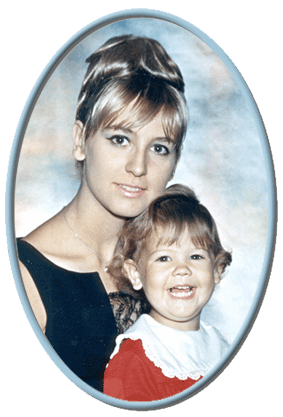
This is my mother. I worshiped her. A little side story: I was born in Burbank. While she was in the midst of starting her divorce (late 1960's), she was in a restaurant with a friend. A man approached her. It was Hugh Hefner. He invited her to become a Bunny. She considered it, but finally declined because of the pending custody battle.

What a strange journey we all travel ...

I am very grateful to have found my way here.

with grace and gratitude,
^_^
 
I became her little helper. I became his 2nd mother. Later, I became her mother, too. I shielded her, wrapped my heart and life around her. I remember the first time I held her as she cried ... it was in the barn. I found her there, and I held her. I was in 6th grade. It wasn't the last time. Never could I let my life make hers any more difficult. I had to bury myself so I could be strong for her and my little brother. I buried those emotions so deep, and I just don't know how to let them out.

I think this answers your questions! Now the work begins.
 
Lily Rose, That picture of your stunningly beautiful mom reminds me of how limited our perspective of people is usually.

I am so glad your journey has led you here. Your presence here is a gift.
 
I too have a story of my mother. She was born to a wealthy family. Her parents were ballet
dancers all over the world. My Grand parents danced in Radio City, Russia with Pavlov, etc.
My mother was raised in boarding schools all her young life. She had five children with no
way to know how to raise them with love. My family ended up a disaster. I feel so hurt and
yet I loved her, she passed just this past April at 95. I feel I did the best with my family yet I was
used and always tried to please everyone. Who knows what is the right way to live. I am not a
selfish person but perhaps I should have been. I am trying to bring back my sons at this time
as they lost their Dad to suicide. I spoiled and did the best I could with my husband, it leaves
me bewildered. He was not physically abusive, just left myself and my boys emotionally abused
by being an absent father, always home, always sleeping or working. I expected no more as I came
from the same. I am so sorry now for my boys. Nancy
 
Dabatross,

"I've been wondering about how fear of future pain can worsen TMS, leading to a vicious cycle recently. It
seems like a mindfulness approach of acknowledging the fear and allowing yourself to feel it before letting it go may work better."

I totally agree. Meditation and mindfullness have lead me to this path as well. I find it works wonderfully. I believe you need to process it (release it, whatever). Sometimes, the simple act of observing it, without judgement is sufficient. Frequently when I observe a physical sensation, I also get an image: Mom, Dad, sister, etc. which then clues me into what "button" is being pushed and I can choose how I respond, vs reacting.

I see it like this. You have an in box and an out box on your "desk" (read: mind/body). Each emotion goes in the in box (at this point you do have a physical sensation. An emotion is ALWAYS followed by an immediate sensation [see "Healing Trauma", Peter Levine]. It may be very subtle though). If you "take it out" and "process it", you can then put it in the out box. If not, the inbox fills up. When it tips over, you have a significant distracting reaction.

Now, with being mindful and combining this with Peter Levine's Somatic Experiencing and felt sense, I notice when the item goes into the in box immediatly. Then, i can process it now and not let them build up. It takes lots of practice (I have been practicing this since the end of 2008). But this is my practice now....and forever. It is my journey and I am loving every minute of not being in severe pain, having ulcers, or any other significantly distracting symptoms.

Matthew
 
Nancy, please close your eyes for a moment and imagine a warm hug.

We all have such complex history, which has all led to us being here. From each other, we learn, and we fortify our inner strength. We are in this, not alone, but with each other.

Suicide is especially difficult, as it carries many faceted aspects. There are stigmas, there is guilt, rage, despair ... the list is long. I do not believe in the stigmas. In the end, suicide is when the pain outweighs the ability to cope. It happens. My stepdad, my best dad, my beloved dad, lost this battle. I was 12. It didn't take me long to understand the lure of simply ending the relentless pain. Our society is not very forgiving towards those that become so overwhelmed.

I forgive. I understand. And I do not dare judge the depth of pain that others feel. I cannot know. No one can really know.

Just offer your love, Nancy .. that is what you can do. And while you are offering that love ... you might turn that bright heart-light to your own self. You are worthy of love and compassion, not just from others, but most importantly, from yourself.

with grace and gratitude,
^_^
 
Nancy, please close your eyes for a moment and imagine a warm hug.

We all have such complex history, which has all led to us being here. From each other, we learn, and we fortify our inner strength. We are in this, not alone, but with each other.

Suicide is especially difficult, as it carries many faceted aspects. There are stigmas, there is guilt, rage, despair ... the list is long. I do not believe in the stigmas. In the end, suicide is when the pain outweighs the ability to cope. It happens. My stepdad, my best dad, my beloved dad, lost this battle. I was 12. It didn't take me long to understand the lure of simply ending the relentless pain. Our society is not very forgiving towards those that become so overwhelmed.

I forgive. I understand. And I do not dare judge the depth of pain that others feel. I cannot know. No one can really know.

Just offer your love, Nancy .. that is what you can do. And while you are offering that love ... you might turn that bright heart-light to your own self. You are worthy of love and compassion, not just from others, but most importantly, from yourself.

with grace and gratitude,
^_^
 
I thank you for the warm hug, it made me feel very good. Suicide is a difficult issue as it so
multifaceted. I suffer for my sons, two of them. They did not deserve this. I feel for you as your
step dad engaged in this. It is Awful!! I know this! Please keep in touch, I need Help, and I hope
I can help you too. Fondly, Nancy
 
Back
Top