• Alan has completed the new Pain Recovery Program. To read or share it, use this updated link: https://www.tmswiki.org/forum/painrecovery/
  • Welcome to the new TMS Wiki server! Things aren't finished yet: email is not set up, so notification and password-reset emails don't go out, and new registrations are paused until email is installed. Details and updates are in this thread (click here). Locked out? Email tmswikisignups@gmail.com from the address where you receive TMS Wiki notifications.

Bring your Questions and Get Answers.. Meet Dr Sharna Prasad

TMS RoundTable Global

Well known member
1f399.png
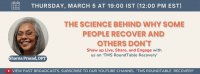
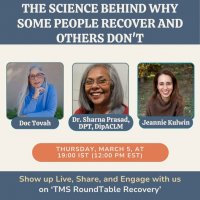
THIS WEEK IN TMS ROUNDTABLE RECOVERY! LIVE Q&A: The Science Behind Why Some People Recover and Others Don’t
There’s a question that haunts people with neuroplastic symptoms: Why do some people fully recover while others stay stuck? The answer isn’t luck, willpower, or the right diagnosis. It lies in the science of how pain actually works... and most people have never been told the truth about it.

That’s why we’re bringing on Dr Sharna Prasad, DPT, DipACLM — a public health professional, public speaker, and self-described “Painiac” who knows this journey from the inside out. Sharna lived with chronic pain herself, and mastering it became the defining experience that drove her passion toward the science of healing.
Today, she works as an outpatient physical therapist treating only complex chronic pain patients at Samaritan Lebanon Community Hospital in rural Oregon. She is a certified Therapeutic Pain Specialist with extensive training in Acceptance and Commitment Therapy (ACT) and holds a Diploma in Lifestyle Medicine. She currently leads shared medical appointments alongside a Rheumatologist, seeing patients with Rheumatoid Arthritis — using the Easy2Care curriculum her team developed, which is grounded in Lifestyle Medicine, social determinants of health, and trauma-informed care.
Whether you’re brand new to the mindbody approach or have been searching for answers for years, Sharna’s lived experience and evidence-based perspective will meet you exactly where you are.
Co hosted by Jeannie Kulwin

1f4c5.png
Thursday, March 5
23f0.png
19:00 Israel (IST) | 12:00 PM Eastern (EST) | 9:00 AM Pacific (PST) | 17:00 London (GMT)
1f534.png
Meet us LIVE on our Facebook Page and YouTube Channel: TMS RoundTable Recovery
Bring your openness, your questions, and your willingness to understand what’s been keeping you stuck. See you there!
https://www.facebook.com/events/891279703680585
 

Attachments

  • 642844580_122223025268274425_8723022056508204659_n.jpg
    642844580_122223025268274425_8723022056508204659_n.jpg
    47.3 KB · Views: 105
  • sharna.jpeg
    sharna.jpeg
    63.5 KB · Views: 210
A summary:

Dr. Sharna Prasad, in her TMS Roundtable Recovery LIVE Q&A titled "The Science Behind Why Some People Recover and Others Don’t" (March 2026), explains that people stay stuck in pain due to a combination of neurobiological, psychological, and social factors that reinforce a sensitised nervous system.

Core Barriers to Recovery
She highlights a persistent belief that "my body is broken", which overrides evidence of safety and keeps protective pain signals active.

High fear of movement or re-injury leads to bracing and avoidance behaviours, trapping individuals in a cycle of threat detection.

Hopelessness—"I'll always hurt"—further signals danger to the brain, blocking engagement with lifestyle shifts like better sleep, nutrition, or social connections.

Path to Breaking Free
Prasad stresses reframing pain as a protective output rather than damage, paired with self-management across health pillars (activity, stress reduction, community). Building competence through small, purposeful actions rebuilds confidence, while community support prevents isolation-fueled stagnation. Those who recover embrace curiosity, let go of medical-model fixation, and prioritize vitality over "cures".
 
Back
Top